

When the indoor unit stops cooling and the outdoor fan drags, the culprit is often a small cylindrical component nobody thinks about until it fails. Air conditioner run capacitors sit inside the condensing unit, providing the phase-shifted current that starts the compressor and keeps the fan motor running smoothly. Picking the right one matters because microfarad ratings, voltage classes, and case shapes all have to match the original part, or the motor will overheat or refuse to spin.
The picks below span single-value, dual-run, and oval styles, covering residential split systems, heat pumps, and even air compressors. Most homeowners with a multimeter and a pair of needle-nose pliers can swap one out in under thirty minutes, so the goal here is matching specs to the unit on the roof or in the side yard, not chasing a specific brand.
How The Shortlist Stacks Up

Turbo 200 Motor Run Capacitor

VEXUNGA 35/5 uF Dual Run Capacitor CBB65B

QYCKFIXR 45+5 uF Dual Run Capacitor CBB65
VEXUNGA CBB60 12.5uF 450V Capacitor
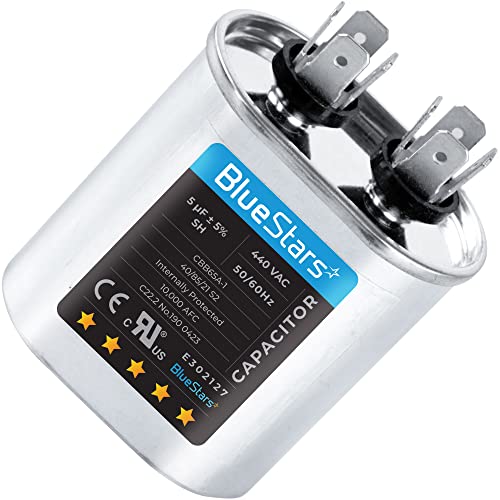
BlueStars 5 uF Oval Run Capacitor

QYCKFIXR 40+5 uF Dual Run Capacitor CBB65

FOCSPROD 35+5 uF Dual Run Capacitor CBB65
What Each Pick Brings To The Table
The Turbo 200 takes a different approach from every other item on this list. Instead of being wound for a single capacitance value, it uses multiple taps on one continuous winding, giving a total of 67.5 microfarads that can be split across several combinations up to 440 VAC. For a working technician, that means fewer SKUs in the van.
Unlike the dual-run capacitors that follow, the Turbo 200 is fluid-filled in a metal can, the older industrial style still favored by pros who service vintage HVAC gear. Each unit ships in its own box and is rated up to 440 VAC, which covers most residential condensing units. For most homeowners, this is overkill, but for anyone who services multiple systems weekly, the convenience shows up fast.
What Makes Sense
- Replaces roughly 200 individual single or dual-value capacitors with one part.
- Continuous winding design tends to hold up well under repeated heating and cooling cycles.
- 440 VAC ceiling handles nearly every residential condensing unit without question.
- Metal-can construction dissipates heat better than plastic-shelled alternatives.
Worth Noting
- Bulkier than the round CBB65 dual-run capacitors used in modern units.
- Tap configuration requires careful labeling during installation, or you can short the wrong circuit.
- Priced higher than single-application replacements, so it only pays off if you actually need the versatility.
Whose Workbench It Belongs On
HVAC service technicians and facilities maintenance crews who need one part to cover many possible ratings on a service call.
Skip It When
A homeowner doing a single DIY swap should reach for the VEXUNGA 35/5 uF instead, since the Turbo 200’s tap system is wasted on a one-off repair.
The VEXUNGA 35+5 hits the most common residential rating on the market, which makes it a sensible pick for the average 1.5- to 3-ton split system. Rated for both 370 and 440 VAC, it slots in whether the original was a 370 or 440 volt part, removing a layer of guesswork before you climb on the ladder.
Measuring about 50mm wide by 85mm tall, this round CBB65B capacitor fits the same mounting strap and terminal layout used by most OEMs. The dual-run designation means one side powers the compressor and the other side powers the fan motor, which is exactly the configuration most central air handlers use. For most homeowners, the swap takes one wire at a time and a photograph of the old part before disconnecting.
Reasons It Performs
- Dual 370/440 VAC rating eliminates one common ordering mistake.
- Compact 50x85mm footprint fits the standard bracket in most condensing units.
- 10,000 AFC fault-current safety rating provides margin under surge conditions.
- ±6% capacitance tolerance matches the original equipment specification.
Points To Keep In Mind
- Always discharge the old capacitor with an insulated screwdriver before touching the terminals, since these store a charge.
- Not a substitute for a single 35 uF or single 5 uF if the unit was originally wired that way.
Right Fit For
Homeowners troubleshooting a failed 35+5 dual-run setup on a standard residential central air conditioner.
Look Elsewhere When
Compressors needing 45+5 or 40+5 ratings will want the QYCKFIXR 45+5 uF or QYCKFIXR 40+5 uF instead.
The QYCKFIXR 45+5 steps up for larger 3.5- to 5-ton systems where the 35+5 in the previous pick would undersize the compressor winding. Built to the CBB65 standard and rated for both 370 and 440 VAC, it carries the same dual-voltage flexibility as the VEXUNGA but with the capacitance bigger units actually draw.
The 45+5 uF rating shows up on a lot of heat pump outdoor units, where the compressor and the fan together pull more current at startup. Compared to the VEXUNGA’s 50x85mm body, the 45+5 case is a touch wider, so checking the bracket space before ordering saves a return. In most heat-pump installs, the upgrade from a failing 35+5 to a proper 45+5 is what finally cools the house on the hottest August afternoon.
Key Advantages
- Proper sizing for larger condensers and heat pumps that draw more startup current.
- Wide 370/440 VAC compatibility covers older and newer units with one part.
- Round CBB65 housing matches OEM mounting hardware in most outdoor units.
- ±6% tolerance keeps motor performance close to the original equipment curve.
Trade Offs
- Slightly larger diameter than the 35+5, so confirm the bracket dimensions before ordering.
- Overkill for smaller 1.5- to 2-ton window units that only need a 25+5 or 30+5 rating.
Quick Facts
Made For
Owners of heat pumps and 3.5- to 5-ton condensers that call for a 45+5 dual-run replacement.
Reach For A Different Pick When
Smaller systems running 35+5 will get along fine with the VEXUNGA 35+5, which costs a little less.
This VEXUNGA CBB60 looks nothing like the round dual-run capacitors used in outdoor condensing units. Instead, it ships as a small 40x70mm cylinder with two lead wires, designed to sit inside the motor housing of an air compressor, a water pump, or a bench grinder. The 12.5 microfarad rating and 450 VAC ceiling cover a lot of single-phase induction motors found in home workshops.
The self-healing metallized polypropylene film construction (the “SH” in the part description) is what gives this style its long service life. Small internal arcs vaporize the metallization around the fault, isolating the bad spot without taking the whole capacitor out. For most garage setups, that means the motor keeps running season after season without the slow loss of capacitance that plagues older oil-filled paper capacitors.
A Few Highlights
- Lead-wire design drops directly into motor housings without a mounting strap.
- Self-healing film construction tolerates small internal faults without failing outright.
- 450 VAC ceiling handles shop motors that briefly spike during startup.
- 50/60 Hz operation fits both U.S. and European motor specifications.
Practical Considerations
- Not a substitute for a 35+5 dual-run capacitor on a residential AC system.
- Wires are not keyed, so labeling the common and run leads before swapping matters.
Best Suited To
DIYers and home mechanics replacing the run capacitor in a single-phase air compressor, pump, or bench motor.
A Better Fit Elsewhere
Anyone working on a central AC condenser should look at the VEXUNGA 35+5 or the QYCKFIXR 40+5 instead.
The BlueStars 5 uF oval capacitor fills a specific niche: small fan motors and the auxiliary side of some heat-pump systems. The oval case shape lets it tuck into brackets where a round CBB65 simply will not fit, which happens more often than expected in older condensers and some package units.
Rated for 370 to 440 VAC with a ±5% tolerance, this part hits the spec most OEM fan motors call for. The 10,000 AFC pressure-disconnect switch acts as a safety vent if the unit ever overheats, preventing the dramatic case rupture that older oil-filled capacitors can suffer. In tight electrical compartments, the 31.5×51.5x55mm body slides into spots the larger 35+5 round capacitors cannot reach.
Bright Spots
- Compact oval body fits brackets where a round CBB65 will not seat.
- ±5% tolerance is tighter than the ±6% common in dual-run units.
- Pressure-disconnect switch vents safely if internal pressure spikes.
- 370-440 VAC range works with most residential fan motor circuits.
Some Limits To Know
- Single 5 uF value is not a substitute for a 35+5 or 45+5 dual-run capacitor.
- Oval cases have a specific orientation, so the strap may need adjusting.
Feature Snapshot
Who Should Grab It
Anyone replacing a 5 uF fan-run capacitor in a heat pump, a window unit, or a small indoor blower motor.
Not Your Match When
Compressor-side dual-run applications need the FOCSPROD 35+5 or the VEXUNGA 35+5, not a 5 uF single.
The QYCKFIXR 40+5 sits right between the 35+5 and the 45+5, and for many 3- to 4-ton condensers that is exactly the rating stamped on the original part. Built to the CBB65 standard with the same 370/440 VAC dual rating as its siblings, it covers a lot of mid-size residential systems without forcing an over- or undersize swap.
Compared to the 35+5 VEXUNGA earlier, the 40+5 case is a hair wider to accommodate the extra capacitance. In most installations, the bracket still accepts it, but measuring the original before ordering prevents a frustrating return. The dual-run terminals (C for common, HERM for compressor, FAN for the motor) match the standard labeling used across the industry, which keeps the wiring step familiar.
Positive Takeaways
- Direct match for the 40+5 rating on many 3- to 4-ton residential condensers.
- 370/440 VAC flexibility covers both older and newer unit vintages.
- Standard CBB65 round housing fits most OEM mounting straps.
- ±6% capacitance tolerance aligns with original equipment specs.
Possible Compromises
- Slightly larger than the 35+5, so verify the bracket space if the original was a smaller case.
- Not the right fit for systems that actually need 45+5 or 35+5, even though the difference sounds small.
Who Will Love This
Homeowners with a 3- to 4-ton system whose failed capacitor reads exactly 40+5 on the label.
Swap It Out When
Heat pumps and larger units calling for 45+5 should go to the QYCKFIXR 45+5 for the proper capacitance.
The FOCSPROD 35+5 lands at the same common residential rating as the VEXUNGA earlier but brings a wider operating temperature window and explicit UL recognition. For attic and garage installations where the condensing unit bakes in summer and freezes in winter, that temperature range is more than a footnote.
At 62mm in diameter and 88mm tall, this round capacitor fits the same brackets as the VEXUNGA 35+5, though the FOCSPROD body is a few millimeters taller. The 10,000 AFC safety rating matches the industry benchmark, and the dual 370/440 VAC rating keeps the ordering question simple. For most homeowners, the deciding factor comes down to the environment, since the FOCSPROD’s wider -40 to +70°C window handles exposed locations better than most.
Standout Benefits
- UL Recognized construction provides a third-party safety check.
- Operating range of -40 to +70°C handles attic and garage extremes.
- Standard CBB65 round housing fits common OEM mounting straps.
- 10,000 AFC fault-current safety rating matches the industry benchmark.
Small Caveats
- A few millimeters taller than the VEXUNGA 35+5, so check the bracket clearance.
- Same 35+5 rating as the VEXUNGA, so the choice often comes down to environment rather than specs.
Technical Highlights
Perfect Match For
Homeowners in hot-summer or cold-winter climates whose condenser sits in an attic, garage, or unshaded side yard.
Where Another Pick Suits Better
Coastal or mild-climate installs can save with the VEXUNGA 35+5, which shares the rating without the premium temperature rating.
What Matters Most Before Choosing Air Conditioner Run Capacitors
Match The Microfarad Rating Exactly
The capacitance value, measured in microfarads (uF or MFD), is the single most important number. A 35+5 dual-run capacitor has two values, 35 uF for the compressor and 5 uF for the fan motor, and substituting a 40+5 or 45+5 part changes the phase shift the motor sees, which leads to overheating, hard starting, and shortened compressor life. Always read the label on the old part before ordering, and never guess based on the condensing unit’s tonnage alone.
Check The Voltage Class
Most residential systems run on 370 VAC or 440 VAC capacitors, and many modern replacements are dual-rated to cover both. Going up in voltage (using a 440 where a 370 was) is acceptable, since the higher insulation just means extra margin. Going down is not, since a 370 volt part on a 440 volt system will fail quickly. For most homeowners, a dual-rated 370/440 VAC capacitor is the safest pick.
Confirm The Case Shape And Size
Dual-run capacitors come in two main shapes: round and oval. The bracket on the side of the condensing unit is sized for one or the other, and the height and diameter both have to clear the service panel. A round CBB65 measuring 50x85mm will not necessarily swap for an oval without bracket modification, so measuring the old part (or the available bracket space) prevents a return.
Choose The Right Configuration
A dual-run capacitor powers both the compressor and the fan motor from one can with three terminals labeled C (common), HERM (compressor), and FAN. A single-value capacitor, like the BlueStars 5 uF or the VEXUNGA CBB60 12.5uF, only powers one motor and has two terminals. Knowing which style the unit needs, by checking the wiring and the label on the old part, keeps the replacement correct the first time.
Key Considerations Across These Picks
Where Shoppers Go Wrong
The single biggest mistake is ordering by the unit’s tonnage rather than the old capacitor’s actual label. A 3-ton system might run 35+5, 40+5, or 45+5 depending on the compressor and the manufacturer, so the right answer is always on the side of the can you are replacing. Owners also sometimes forget to discharge the old capacitor before touching the terminals, which can deliver a memorable shock even after the power is off. A screwdriver with an insulated handle across the two terminals, done a few times, drains any stored charge before the swap.
Where The Extra Money Goes
The jump from a basic 35+5 round capacitor to a UL Recognized or wider-temperature-range model, like the FOCSPROD, pays for third-party safety testing and tougher internal construction. In attics, garages, and sun-baked side yards, those upgrades stretch the service life from a few summers to a decade or more. In mild climates, the same money buys little real-world benefit, so the right call depends on where the condenser actually lives.
Frequently Asked Questions
How Do I Know Which Capacitor My Air Conditioner Needs?
Read the microfarad and voltage label printed on the side of the existing capacitor, and use the same rating for the replacement. A dual-run capacitor will show two values like 35+5 uF, while a single-value part shows one. Matching the case shape (round or oval) and the terminal count keeps the swap straightforward.
Can I Replace A 370 VAC Capacitor With A 440 VAC One?
Yes, going up in voltage is fine because the higher rating just means more insulation margin. Going down from 440 to 370 is not safe, since the lower-rated part will fail quickly on a 440 volt system. Many modern replacements are dual-rated 370/440 VAC, which sidesteps the question entirely.
What Happens If I Install The Wrong Microfarad Rating?
A lower-than-spec capacitance causes hard starting, higher amp draw, and eventual compressor overheating. A higher-than-spec value creates a stronger phase shift that overheats the motor windings and can shorten the motor’s life. Either direction of mismatch stresses the system, so matching the original rating is the safest move.
How Long Do Air Conditioner Run Capacitors Usually Last?
Most residential run capacitors last between 8 and 15 years, depending on heat exposure, cycling frequency, and manufacturing quality. Attic and garage installs shorten the lifespan, while shaded coastal locations extend it. The first symptom is usually a humming outdoor unit that does not start, or a fan that spins slowly while the compressor stays still.
Is It Safe To Replace A Run Capacitor Without A Professional?
Homeowners comfortable with basic electrical work can swap a run capacitor after shutting off the breaker, discharging the old part, and labeling the wires. Anyone uncertain about working around 240 volt circuits, or uncomfortable discharging a capacitor, should call an HVAC technician. The part itself is inexpensive, but the shock risk before the unit is discharged is real.