

Picking the right manifold gauge set saves you a costly shop visit the next time your home or car A/C acts up. These tools read refrigerant pressure on the high and low sides of a system, letting you check charge levels, hunt for leaks, and recover old gas before a recharge. Most weekend mechanics and HVAC tinkerers reach for a basic 3-way manifold, then graduate to a vacuum pump combo once evacuation becomes part of the routine. The seven picks below cover that full arc, from simple diagnostic dials to full pump-and-gauge kits ready for deeper service work.
An Overview Of The Picks
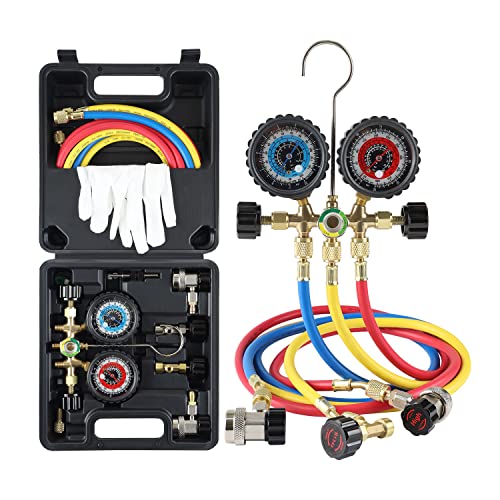
Lichamp R134a R22 R12 R502 Diagnostic Manifold Gauge Set

Lichamp HVAC R410A Manifold Gauge Set

OMT 4 CFM AC Vacuum Pump and Gauge Set

OMT 3-Way AC Manifold Gauge Set

OMT 3-Way AC Manifold Gauge Set (R410A)

VTG VOGTEN 4.5 CFM AC Vacuum Pump and Gauge Set

Air Conditioner Refrigerant Low/High Pressure Gauge 70mm
The Details Behind The Selections
The Lichamp 3-way manifold is the kind of tool that earns a permanent spot in a weekend mechanic’s drawer. Its colored dials display pressure in Fahrenheit-scaled units, with the red high-side gauge rated to 500 psi and the blue low-side to 350 psi, which covers the working range of older R12, R22, R134a, and R502 systems still found in pre-2010 vehicles and central air units.
You get a 5-foot hose set that gives you slack to work around a bulky engine bay without yanking on fittings. For most home garages, that’s enough reach to keep the manifold itself resting on a fender cover while the couplers click onto the service ports.
Positive Points
- Color-coded dials make high-side and low-side readings easy to tell apart at a glance
- Works with the legacy refrigerants still common in older cars and household units
- 5-foot hoses offer comfortable working distance on most sedans and light trucks
- Solid entry point for first-time manifold owners learning pressure diagnostics
Worth Noting
- No pump included, so evacuating moisture from a system requires a separate vacuum purchase
- Pressure ratings sit below the R410A class, limiting usefulness on modern mini-splits
- Hose gaskets tend to wear with heavy shop use and may need occasional replacement
Right Fit For
First-time tinkerers servicing a 1990s or early-2000s vehicle whose factory refrigerant is still R134a or R12.
Consider Something Else When
Homeowners with a newer mini-split system should look at the Lichamp HVAC R410A Manifold Gauge Set, since its 800/550 psi ratings match modern refrigerant pressure.
Step into a modern residential system and the pressure numbers climb well past the older R22 era. This Lichamp kit handles that jump with a red high-side gauge rated to 800 psi and a blue low-side gauge to 550 psi, paired with hoses and a sight glass built for the higher pressures R410A and R32 demand.
Where the first Lichamp covered only legacy refrigerants, this one broadens the cross-reference list to R134a, R22, R32, and R410A. For homeowners juggling a window unit, a central air handler, and a ductless mini-split, that means one manifold body across the whole household.
Where It Excels
- Pressure ceiling matches modern R410A running pressures, avoiding pegged needles
- Built-in sight glass helps you watch refrigerant flow during charging
- Covers four refrigerants in one body, useful for mixed-vintage homes
- Same hose length and color layout as the legacy Lichamp, so upgrading feels familiar
Trade Offs
- No vacuum pump included for full evacuation jobs
- Does not cover the newest R454B blend, which appears in equipment made from 2025 onward
Key Product Details
Best Suited To
Homeowners maintaining ductless mini-splits and central air handlers that run R410A or R32 refrigerant.
A Better Fit Elsewhere
Techs handling brand-new 2025+ equipment with R454B should reach for the OMT 3-Way AC Manifold Gauge Set for R410A R32 R22 R454B, which lists that blend on its compatibility roster.
Pulling a deep vacuum before recharging an A/C system is the step most casual owners skip, and it is also the step that decides whether the new refrigerant stays clean. The OMT bundle solves that by pairing a 4 cfm single-stage pump with a 3-way manifold, R134a couplers, can taps, a leak detector, vacuum oil, and the hoses to connect it all.
Compared with the bare Lichamp manifolds earlier in this list, this kit is the first one that lets you complete a full service cycle: recover, evacuate, recharge, and recheck. For shade-tree mechanics working on daily drivers, the all-in-one nature removes the guesswork of matching fittings and adapters.
Reasons It Performs
- All-copper motor in the pump supports longer runtime without overheating
- Aluminum alloy housing sheds heat and shrugs off chemical splash in the shop
- Self-sealing and puncture-style R134a taps cover different bottle formats
- Leak detector included so you can chase down small losses before recharging
Points To Keep In Mind
- Heavier and bulkier than a manifold alone, so storage needs a dedicated shelf
- Oil level must be checked before each use to avoid pump damage
- Not built for R410A high-side pressures seen on residential mini-splits
Made For
Shade-tree mechanics performing full automotive A/C recharges in a home garage with standard 110V outlets.
Skip It When
Residential HVAC-focused shoppers who never service vehicles should consider the VTG VOGTEN 4.5 CFM AC Vacuum Pump and Gauge Set, which leans toward mini-split evacuation.
The OMT 3-Way set targets the same legacy refrigerant crowd as the first Lichamp, but it leans harder on readability. The XL gauge dials are noticeably larger than economy sets, with thick Fahrenheit markings that stay legible under a hood lamp or in a dim basement mechanical room.
The 5-foot hose run matches the Lichamp length, and the refrigerant compatibility list (R134a, R12, R22, R502) mirrors the first pick almost exactly. The honest read is that this is a dial-and-hose upgrade for someone who already knows they want a sturdier faceplate but does not need a vacuum pump yet.
Why It Works Well
- Oversized dial faces reduce squinting during late-evening repairs
- Calibration screw on each gauge supports zeroing drift over time
- Carry pouch often included for tidy storage between jobs
Small Caveats
- Still no pump, so evacuation requires a separate purchase
- Same legacy pressure ceiling as the Lichamp R134a set, so R410A is off the table
Feature Snapshot
Who It Suits Best
Home garage hobbyists who already understand manifold basics and simply want larger, clearer dials.
Look Elsewhere When
Anyone needing a bundled pump-and-gauge experience should consider the OMT 4 CFM AC Vacuum Pump and Gauge Set, which adds evacuation to the same compatibility list.
New refrigerant blends are landing in residential equipment, and many older manifolds cannot read them safely. This OMT kit is purpose-built for that shift, listing R410A, R32, R22, and the newer R454B on its compatibility roster, with 2.6-inch shock-resistant gauges rated from -15 to 500 psi on the low side and -15 to 800 psi on the high side.
The included R410A and R32/R454B adapters plus R410A and R12/R22 safety valves remove a lot of the “wait, do I have the right fitting” hesitation. For a working tech servicing mixed-fleet residential calls, that built-in coverage is a real workday upgrade.
A Few Strong Suits
- Reads the new R454B blend appearing in post-2025 equipment
- Wide psi range covers R410A peaks without pegging the needle
- Adapters and safety valves bundled so you are not chasing parts mid-job
- Shock-resistant gauge movement helps on rough service truck rides
Honest Caveats
- No pump included, so evacuation still requires a separate unit
- Higher price tier than entry manifolds aimed at hobbyists
Who Will Love This
Working HVAC technicians and serious DIYers whose service mix now includes R454B and R32 systems.
Not Your Match When
Budget-focused shoppers working only on R134a automotive systems should consider the Lichamp R134a R22 R12 R502 Diagnostic Manifold Gauge Set, which costs less and fits legacy cars.
When the system you are evacuating is a long line set on a ductless mini-split, every extra cubic foot per minute matters. The VTG VOGTEN pump runs at 4.5 cfm, half a step above the OMT 4 cfm unit, which shortens the time you sit watching a micron gauge creep down.
The package rounds out with a 3-way manifold, three color-coded 4-foot rubber hoses (red high, blue low, yellow fill), quick couplers, R410A adapters, R134a can taps, vacuum oil, and a valve core wrench. Hoses carry a 600 psi working pressure and 3000 psi burst rating, which is reassuring when charging higher-pressure systems.
Benefits That Matter
- Higher cfm rating trims evacuation time on longer line sets
- Aluminum pump housing dissipates heat during extended pulls
- Top hook on the manifold frees both hands while adjusting valves
- Burst-rated hoses offer safety margin on R410A jobs
Potential Drawbacks
- Pump runs on 110V only, limiting field use without shore power
- Heavier than manifold-only kits, so plan for a sturdy storage spot
Quick Facts
Perfect Match For
Homeowners and small-shop techs evacuating mini-split line sets and looking to cut time off each pull.
Reach For A Different Pick When
Those focused on R410A-heavy residential work may prefer the OMT 3-Way AC Manifold Gauge Set for R410A R32 R22 R454B, which is purpose-built around modern blends.
Sometimes you only need a quick spot check, not a full manifold setup. The gohantee 70mm gauge is a standalone dial pair, with a 1/8″ NPT inlet that threads into existing test ports or custom manifolds. The blue low-pressure dial covers 0 to 500 psi, and the red high-pressure dial tracks 0 to 800 psi, covering R22, R134a, and R410A systems.
The 2.7-inch face is small enough to keep in a glovebox or HVAC tool roll, and the price point makes it approachable for someone adding a dedicated gauge to an existing manifold. Think of it as a backup or a specialty tool, not a full replacement for the kits above.
Advantages To Know
- Compact form factor fits in tight service truck drawers
- Wide refrigerant compatibility for the price tier
- Clear scale markings support quick field readings
Where It May Fall Short
- No hoses, valves, or pump included, so it cannot run a full service on its own
- Lacks the calibration hardware and storage case of full manifold sets
Feature Card
Whose Shelf It Belongs On
Techs and homeowners who already own a manifold and want an inexpensive backup gauge for spot checks.
Swap It Out When
Someone starting from scratch should reach for the Lichamp R134a R22 R12 R502 Diagnostic Manifold Gauge Set, which comes with the hoses and valves this standalone dial omits.
Matching Refrigerants, Pressure Ratings, and Pump Needs
Start with the refrigerant your system actually uses, because the pressure ceiling of the gauge has to clear the highest reading the system will produce. R134a tops out around 300 psi on the high side, while R410A and R32 climb past 400 psi, and the newer R454B blend runs similar pressures. A gauge rated to 500 psi handles older automotive and R22 work fine, but a 800 psi high-side scale covers modern residential equipment without pegging the needle.
A “3-way manifold” refers to a gauge block with three ports and valves controlling low-side, high-side, and a center line used for charging or recovery. Two-way manifolds exist but offer less control during charging.
Pump capacity, measured in cubic feet per minute (cfm), determines how quickly a vacuum pump can evacuate moisture and non-condensables from a system. A 4 cfm pump suits most car and small residential jobs, while 4.5 cfm trims time on long mini-split line sets. Evacuation is the act of pulling that vacuum before recharging, and skipping it leaves moisture inside that can damage the compressor.
Hose length and color coding matter more than they look at first. Red hoses always run to the high-side port, blue to the low-side, and yellow to the refrigerant source or vacuum pump. A 5-foot hose gives working slack on most vehicles, while 4-foot hoses keep the bundle compact for tight equipment closets. Look for hoses with stated working and burst pressure ratings, since under-rated hoses are the most common failure point during a charge.
Calibration screws on each gauge let you re-zero the needle if readings drift after storage. For a $5 to $10 tool, this is the kind of feature that separates a manifold you trust from one you second-guess every summer.
Key Considerations Across These Picks
Common Shopping Slip Ups
The most frequent mistake is buying a manifold that does not list your refrigerant on its compatibility chart, then discovering mid-service that the high-side pegs past 500 psi. Always match the gauge to the refrigerant label, not the other way around. Another trap is skipping the vacuum stage because the kit lacks a pump: a partial charge without evacuation introduces moisture that corrodes the system from the inside. Finally, do not overlook hose thread and fitting type, since R410A systems often need 5/16″ adapters that legacy R22 hoses do not have.
Where The Extra Money Goes
Spending more on a pump-and-gauge bundle usually buys a copper-wound motor that runs cooler, an aluminum housing that sheds heat, and higher cfm ratings that shorten evacuation time. Premium kits also tend to include the adapters, safety valves, and can taps that you would otherwise source separately. The honest upgrade math is simple: if you service more than one refrigerant family per year, the bundled kit pays for itself in saved trips to the parts counter. If you only need a quick spot check, a standalone dial like the gohantee is the leaner buy.
Frequently Asked Questions
What size manifold gauge do I need for a home A/C unit?
A standard 3-way manifold rated to 800 psi on the high side handles most R410A and R32 residential systems, while a 500 psi high-side gauge is enough for older R22 units. For mini-splits, confirm the kit includes 5/16″ adapters before you buy.
Do I really need a vacuum pump for a recharge?
Evacuation removes moisture and air that damage compressors and reduce cooling efficiency. A recharge without a proper vacuum pull works for a few weeks, then the system’s performance drops and corrosion begins.
Can one manifold cover both car and home A/C?
Yes, provided the gauge covers the refrigerant your car uses (usually R134a) and the higher pressures of your home system. Bundled kits like the OMT 4 cfm set and VTG VOGTEN set cover both worlds in one case.
How do I know which refrigerant my system uses?
Check the data plate on the outdoor condenser or the service port labels. R22 was standard before 2010, R410A dominated the 2010s, and R454B is appearing in equipment made from 2025 onward.
What is the difference between R32 and R410A?
R32 is a single-component refrigerant, while R410A is a blend of R32 and R125. Both run at similar high-side pressures, and most modern gauges handle both without recalibration.