
A stuffy bedroom in July, a home office that never quite catches a cross-breeze, a kitchen that traps cooking heat: that’s where a good air circulator earns its keep. Whole-room airflow matters more than raw speed, and the right fan can reshape how a space actually feels. The picks below cover bladeless towers, smart desk models, gentle pedestals, and compact table options, each one suited to a different room and routine.
A Fast Comparison Of The Options

Shark TurboBlade Bladeless Tower Fan (Charcoal)

DREO Smart Fan for Bedroom, 12-Inch, 85 ft Airflow

DREO Smart Fan for Bedroom, 12-Inch, 85 ft Airflow

PELONIS Omni-Directional Air Circulator Fan with Remote (Grey)

PELONIS Omni-Directional Air Circulator Fan with Remote (White)

DR.PREPARE Oscillating Air Circulator Table Fan, 11.3-Inch
PELONIS 7-Inch Air Circulator Pedestal Fan, Black
The Strengths Of Each Pick
Where the two DREO desk models lean into app and voice control, the Shark TurboBlade leans into pure mechanical personality. The bladeless tower pivots from vertical to horizontal, twists the vents in two directions, and sweeps 180 degrees side to side, which means airflow can follow you around a couch instead of freezing on one cushion.
Living rooms and open-plan spaces benefit most, because the pivoting head lets you redirect cool air without dragging the unit across the floor. A magnetic remote keeps adjustments within reach from the sofa, and the bladeless body wipes clean in seconds. In most households, that combination cuts the daily maintenance to almost nothing.
Noteworthy Benefits
- 10 speed settings plus 10 noise levels for fine control over a room’s sound and chill.
- DustDefense technology on a sealed bladeless body, which wipes down in seconds.
- 180-degree oscillation plus pivoting vents for airflow that tracks where you sit.
- Magnetic remote stores neatly on the tower so it stops disappearing into the couch.
Things To Consider
- Tower footprint can crowd tight corners, and the pivoting head needs clearance to swing fully.
- Smaller bedrooms may find even the lowest settings a touch punchy for sleeping.
- Owners commonly report the charcoal finish shows dust more than a lighter color would.
Who It Suits Best
Open living spaces where multiple people want different airflow angles from the same fan.
Skip It When
The PELONIS Omni-Directional Air Circulator with Remote (Grey) suits a quiet nursery better, where gentler vertical and horizontal sweep matters more than ten speed steps.
Where the Shark TurboBlade brings drama to a shared room, this 12-inch DREO brings hush to a bedside table. TurboWind technology pushes air up to 85 feet, so the breeze reaches across a long bedroom or down a narrow home-office hallway without needing to be repositioned. The motor holds around 20 dB on lower settings, which sits well below typical conversation.
9 speed steps and a 12-hour timer cover most sleep and workday routines. App and voice control let you tweak settings without leaving the bed, and 90-degree vertical plus 90-degree horizontal oscillation spreads the air without a hard directional blast. For anyone who reads before sleep, that softer coverage usually beats a stronger tower fan.
Useful Strengths
- Long-throw airflow up to 85 feet reaches deep into long rooms and lofts.
- ~20 dB minimum noise keeps the unit bedroom-friendly for light sleepers.
- 9 speeds and an 8 or 12 hour timer match evening wind-downs to overnight cooling.
- Compact 12-inch desk footprint suits nightstands and small work surfaces.
Worth Noting
- App pairing requires Wi-Fi and a quick setup the first time you power it on.
- At full speed, the 85 ft throw can feel stronger than some compact rooms need.
Key Specs
Right Fit For
Bedrooms and home offices where low noise and long-throw coverage matter more than a tower’s presence.
Where Another Pick Suits Better
The Shark TurboBlade Bladeless Tower Fan is the better match for an open living room that needs pivoting vents and 180-degree oscillation instead of a desk-friendly footprint.
This second DREO shares the same TurboWind motor and 20 dB floor as its sibling, but ships in a slightly different package. The same 90-degree vertical and 90-degree horizontal oscillation means it can blanket a room in two directions at once, which is rare for a 12-inch unit. In a dorm or studio, that kind of coverage usually replaces two separate fans.
App and voice control come in handy when your phone is across the room or your hands are full. The 7-inch blade diameter and roughly 9.45 by 9.45 inch base keep it stable on crowded desks. For most dorms, that’s a smart upgrade over a basic box fan.
What It Does Well
- 3D oscillation covers both height and width without manual aiming.
- App and voice control reduce physical adjustments during a busy day.
- Compact base fits small surfaces like nightstands and dorm desks.
Trade Offs
- Smart features add setup time versus a plain button-controlled desk fan.
- Smaller blade diameter produces less raw airflow than a pedestal unit.
Who Will Love This
Connected households and dorm residents who want app and voice control in a compact 12-inch package.
Not Your Match When
The DR.PREPARE Oscillating Air Circulator Table Fan is a better fit for anyone who wants simple button controls and a smaller price point without smart features.
Where the DREO desk fans focus on one spot, the PELONIS AeroFan spreads its attention everywhere at once. The pedestal body automates 135 degrees of horizontal sweep and 90 degrees of vertical tilt through 3D OmniFlow oscillation, so you stop aiming the head manually. The bionic butterfly-style blade widens the breeze into something soft rather than a single hard stream.
Fitted bedrooms and family rooms benefit most from that draft-free sweep. The included remote saves you from walking across the room, and the grey finish blends with most furniture. In most homes, this pedestal becomes the room’s main circulator rather than a backup.
The Case For It
- Automated 3D oscillation removes the need to manually aim the head.
- Bionic butterfly blade softens the breeze for sensitive sleepers.
- Pedestal height reaches across couches and across cribs alike.
- Remote control fits bedside and living-room routines.
Points To Keep In Mind
- Pedestal base takes up more floor space than a tower or desk model.
- Assembly is required on first setup, which takes a few extra minutes.
Feature Snapshot
Made For
Family rooms and master bedrooms where a pedestal height and gentle sweep match the routine.
Look Elsewhere When
The PELONIS 7-Inch Air Circulator Pedestal Fan suits a small apartment better, where a compact 7-inch head and adjustable height fit tight corners more easily.
The white twin of the grey PELONIS carries the same 3D OmniFlow oscillation and bionic butterfly-style blade, so the airflow behavior matches. The white finish simply fits nurseries and lighter decor better, and in most nurseries that’s a meaningful reason to pick this version over the grey.
Children, older family members, and light sleepers usually respond well to the wider, softer breeze. The remote and pedestal height keep adjustments out of curious hands on the floor. In most family homes, the choice comes down to color, and white wins for shared spaces.
Key Advantages
- Soft, draft-free breeze suits nurseries and elderly family members.
- White finish blends with light walls and shared bedrooms.
- 3D oscillation covers the room without manual aiming.
Honest Caveats
- Same pedestal footprint as the grey model, which still requires floor space.
- White housing can show scuffs faster than darker finishes over time.
Best Suited To
Nurseries, guest bedrooms, and shared family spaces where a soft breeze and a light finish matter.
Reach For A Different Pick When
The DREO Smart Fan for Bedroom is a better match for a tech-forward home office that prefers app and voice control over a pedestal’s footprint.
Where the PELONIS pedestals command floor space, the DR.PREPARE table fan keeps things compact. At 11.3 inches tall, it tucks onto a kitchen counter, a dorm desk, or a workshop bench without crowding. The 70-degree horizontal oscillation and 100-degree vertical manual tilt handle most small-room angles through a single aiming.
Button controls keep the unit simple, which matters in a kitchen or workshop where a phone-based app gets in the way. The 6.5-inch airfoil blade stirs a softer breeze than a small motor fan. In most tight spaces, that’s a clear upgrade over a basic desk fan.
What Stands Out
- Compact 11.3-inch height fits counters, dorm desks, and windowsills.
- 70-degree auto-oscillation plus 100-degree tilt covers most room angles.
- Simple button controls avoid app setup in kitchens and workshops.
- 3 speed settings match most small-room needs without overcomplicating use.
Possible Compromises
- Smaller blade limits raw airflow compared to the DREO and PELONIS units.
- No remote, so manual button presses are required for every change.
Feature Rundown
Perfect Match For
Kitchens, dorm rooms, and small offices where a short table footprint and simple buttons matter most.
A Better Fit Elsewhere
The PELONIS Omni-Directional Air Circulator with Remote (Grey) is a better match for a larger bedroom that benefits from a pedestal height and 3D oscillation.
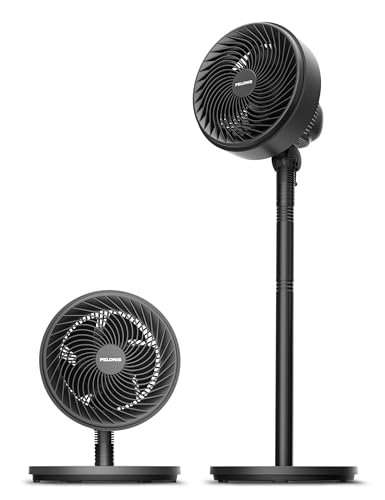
Where the larger PELONIS pedestals use a wider bionic blade, this 7-inch model leans on a 5-blade airfoil design that pushes up to 549 CFM. Four height options let it shrink to a tabletop fan or grow into a standing pedestal, which makes it easier to fit under a loft bed or behind a couch. The 75-degree horizontal plus 90-degree vertical oscillation spreads air across small apartments without manual aiming.
Manual controls keep the unit simple, and at roughly 30 dB the motor stays polite during calls and sleep. The black finish hides scuffs better than the white PELONIS does. In most studios, that compact pedestal becomes the single fan that handles the whole room.
Notable Gains
- 4 height options convert between tabletop and standing pedestal.
- 549 CFM airflow covers a studio from one outlet.
- ~30 dB operation stays polite during calls and sleep.
- 5-blade airfoil design smooths the breeze across a wide area.
Some Limits To Know
- Manual controls require you to walk to the unit for adjustments.
- 7-inch head produces a tighter stream than larger pedestal circulators.
Product Snapshot
Whose Shelf It Belongs On
Small apartments and shared bedrooms where one pedestal needs to serve as both a tabletop and standing fan.
Swap It Out When
The Shark TurboBlade Bladeless Tower Fan is a better fit for a living room that wants a bladeless aesthetic and pivoting vents over an adjustable pedestal.
What To Weigh Before Choosing Air Circulating Fans
Match The Fan To The Room Size
A 12-inch desk model rarely fills a 20 by 20 foot living room, and a 7-foot tower usually overwhelms a nursery. Airflow reach, measured in feet or CFM (cubic feet per minute, the volume of air moved each minute), tells you how far a fan can push air before it loses strength. Long rooms reward long-throw fans like the DREO 12-inch models, while small bedrooms do fine with a compact DR.PREPARE table unit.
Decide Between Oscillation Patterns
Standard fans sweep side to side, which works for most living rooms. 3D oscillation adds a vertical tilt so the head can push air up toward the ceiling and back down again, useful for rooms with high ceilings or vaulted architecture. The PELONIS AeroFan pair and the DREO desk models both automate that vertical sweep, while the DR.PREPARE and Shark units require manual tilting.
Match Noise To The Routine
Bedrooms and nurseries need fans that drop to 20 to 30 dB (decibels, a logarithmic unit of sound loudness) on low settings. Open living rooms can tolerate more noise in exchange for higher airflow. The DREO 20 dB floor and the PELONIS 7-inch 30 dB rating point to clear use cases before you look at speeds or smart features.
Choose Controls That Match Daily Habits
App and voice control save you from leaving the bed or couch, but require Wi-Fi setup. Manual buttons and remotes keep things simple and reliable during a power or network hiccup. The Shark TurboBlade and the DREO units lean smart, while the DR.PREPARE and the PELONIS 7-inch model stay manual for kitchen and workshop convenience.
Common Shopping Slip Ups And Where The Extra Money Goes
Where Shoppers Go Wrong
A common mistake is buying on peak airflow alone. Raw CFM sounds impressive, but a drafty stream pointed across a small bedroom can keep a light sleeper awake. Another is ignoring oscillation range, since a fan that only sweeps 70 degrees will leave a hot corner untouched. Measure the room, then match the sweep and the CFM to the layout.
When Paying More Pays Off
Higher-tier models in this category typically add quieter motors, longer oscillation, and 3D automation. The Shark TurboBlade pivots its vents and twists to fit odd layouts, the DREO units add app and voice control, and the PELONIS pedestals automate both horizontal and vertical sweep. For a primary living space or a daily-use bedroom, those upgrades usually justify the step up from a basic desk fan.