
Cold shoulder seasons keep most above-ground pools closed for half the year, which is a shame when you have a backyard that’s perfectly serviceable from April through October. The right electric pool heater stretches your swim window by weeks at both ends, and modern heat pumps have gotten genuinely efficient, pulling warmth from the air even on mild days. This list rounds up six solid options worth a look, mixing solar panels for sun-soaked yards and heat pumps for dependable, set-and-forget warmth.
How The Shortlist Stacks Up

SolarPoolSupply Solar Pool Heater Panel Replacement (4′ x 12′)

SolarPoolSupply DIY Solar Pool Heater Kit (4-4×10)

AQUASTRONG Pool Heat Pump for 5000 Gallons

AQUASTRONG Pool Heat Pump for 14’x22’x48″ Pools
AQUASTRONG Pool Heat Pump for 16000 Gallons

Varpoolfaye 16000BTU Pool Heat Pump for 5000 Gallons
The Picks, Examined More Closely
Already running a solar array on your pool and staring down a cracked or underperforming panel? This 4-by-12-foot replacement drops into a hose-and-clamp manifold system with a 1.5-inch inner-diameter header, so the swap is more about elbows than engineering. The absorber surface is built for high heat capture, which means the new panel plays nicely with whatever’s already mounted beside it.
For most homeowners replacing a single dead panel, this matches existing setups without forcing a full re-plumb. Compared to the DIY kit below, it skips the fittings and headers, since you’re working with what’s already there.
What Earns Its Place
- Universal fit for hose-and-clamp solar manifolds, so replacing one bad panel doesn’t mean rebuilding the array.
- High-output absorber that helps the panel pull serious heat even on partly cloudy afternoons.
- Rated for a 15-20 year service life, which is the kind of longevity that lets you forget about it for a decade.
- Manageable 4-by-12-foot footprint that fits typical roof rack and fence-line mounting plans.
Things To Consider
- Won’t help anyone starting from scratch; this is a repair part, not a full system.
- Roof or rack mounting hardware typically isn’t included, so budget for racking separately.
- Solar performance drops sharply in late fall, so plan on closing the pool once nights turn cold.
Who It Suits Best
Pool owners with an aging solar array who need to swap out one failed panel without re-engineering the whole setup.
Where Another Pick Suits Better
First-time installers get a better starting point with the SolarPoolSupply DIY Solar Pool Heater Kit, which ships the panels, headers, and fittings in one box.
Got a sunny backyard, a free Saturday, and a pool that sits cold through May? The DIY kit bundles four 4-by-10-foot panels with the headers, manifolds, and fittings needed to plumb a working solar loop. The headers use a 1.5-inch inner diameter, which is the most common size for residential pool plumbing.
The over-molded header design is the quiet win here, since it keeps water flowing smoothly without the bottlenecks that plague older DIY arrays. For handy homeowners, this is the kind of kit that turns a weekend into a real swim-season extension.
A Few Highlights
- Four-panel configuration produces meaningful temperature lift for medium-sized above-ground pools.
- Smooth-bore header reduces flow restrictions, which keeps the existing pump from working overtime.
- Same 15-20 year longevity as the replacement panel, so the up-front effort pays off for a long time.
- All-in-one kit cuts the parts-store scavenger hunt down to plumbing tape and clamps.
Worth Noting
- Requires a pump, filter, and basic PVC skills; not a project for someone who’s never held a pipe cutter.
- Heating output swings with sun exposure, so shaded yards see much weaker results.
- Roof or ground-mount framing is sold separately, and that’s often the biggest surprise line item.
Feature Snapshot
Made For
DIYers with a sun-exposed yard and a working pump who want a no-electricity way to push the swim season earlier and later.
Skip It When
Shaded lots or homeowners without plumbing comfort should look at the AQUASTRONG Pool Heat Pump for 5000 Gallons, which runs on standard power and works regardless of cloud cover.
Heat pumps work like a reversible air conditioner for your pool, pulling warmth from the outside air and dumping it into the water. The AQUASTRONG for 5000-gallon pools leans into that idea with a dual-mode setup, heating between roughly 59 and 104 degrees Fahrenheit while also cooling water when summer turns brutal. That cooling side is something most pool heaters don’t offer.
For most small above-ground setups, a 16,000 BTU module sized for 5,000 gallons hits a sensible balance: enough muscle to keep the water swimmable, small enough not to crush the electric bill. Compared to the solar options above, this is a set-and-forget appliance rather than a roof-rack project.
Advantages To Know
- Dual heating and cooling mode extends comfort from spring through peak summer in one unit.
- Rated for 5000-gallon pools, which covers most round and oval above-ground models.
- Runs on standard residential power without solar exposure or a perfectly oriented roof.
- Reversible operation means a hot August pool can get dialed back to a refreshing 75 degrees.
Trade Offs
- Heat pumps lose efficiency as outdoor temps drop, so very cold shoulder seasons still need a solar assist or a cover.
- Compressor noise at startup is noticeable in tight yards, though modern units are much quieter than older generations.
- Sized for smaller pools, so anyone with a 10,000+ gallon setup should look up to the 16,000-gallon model.
Feature Snapshot
Right Fit For
Owners of smaller above-ground pools who want a single unit that handles both shoulder-season warming and peak-summer cooling.
Consider Something Else When
Pool owners with bigger volumes or smart-home setups may find the AQUASTRONG Pool Heat Pump for 14’x22’x48″ Pools a better match, with its larger capacity and app control.
Round above-ground pools in the 14-by-22-foot range are common, and this heat pump is sized specifically for that footprint at a 48-inch wall height. The wider heating range, down to about 47 degrees Fahrenheit, means it can pull heat from cooler air than the smaller 5,000-gallon model above, which extends the swim season deeper into fall.
You may find the smartphone app control a real quality-of-life upgrade, since it lets you nudge the temperature from the porch instead of walking to the equipment pad. In our view, that’s the kind of feature that quietly makes a backyard pool feel more like a daily amenity and less like a weekend chore.
Notable Gains
- Wider low-end heating range lets it work in cooler shoulder seasons where smaller pumps stall out.
- App-based control means temperature adjustments happen from the kitchen, not the equipment pad.
- Built for standard 14-by-22-foot above-ground pools, which removes sizing guesswork.
- Heating and cooling dual mode handles the full calendar, not just the warm months.
Points To Note
- App-dependent features assume stable Wi-Fi at the equipment pad, which isn’t always a given.
- Larger capacity comes with a larger physical footprint, so plan equipment-pad space accordingly.
- Commonly reported behavior includes a brief ramp-up period on first cold-day startup, so a pool cover helps significantly.
Who Should Grab It
Tech-comfortable pool owners with a standard 14-by-22-foot above-ground pool who want remote control and broader seasonal range.
Not Your Match When
Smaller pools get a better match with the AQUASTRONG Pool Heat Pump for 5000 Gallons, which avoids paying for capacity the pool can’t use.
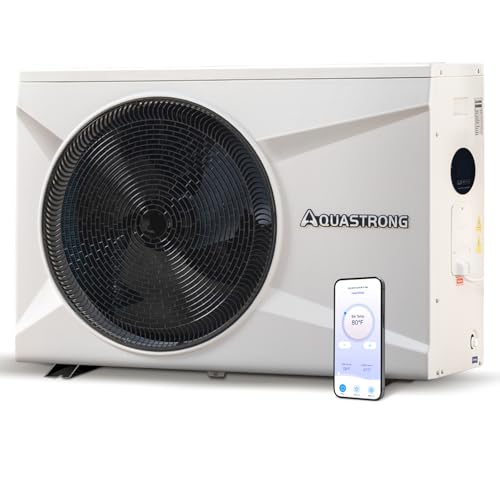
Stepping up to roughly 16,000 gallons puts you in mid-sized above-ground and entry-level in-ground territory, and that volume demands serious heating muscle. This AQUASTRONG unit covers it with a dual-mode heat pump that heats from about 47 to 104 degrees Fahrenheit and cools from 47 to 83. The wide low-end range is the real talking point, since it lets the unit work in conditions that stop smaller pumps cold.
For most homeowners with a larger pool, a properly sized heat pump like this one means the difference between a May-to-September season and a March-to-October season, which doubles the swim window in many climates. Compared to the smaller AQUASTRONG above, this trades the compact footprint for the kind of output a bigger pool actually needs.
The Case For It
- 16,000-gallon capacity covers most mid-sized above-ground and small in-ground pools.
- Heating range down to 47 degrees Fahrenheit means the pump still works on cool fall mornings.
- Year-round dual mode covers the full calendar, from crisp spring swims to hot August afternoons.
- Heat pump efficiency typically beats gas heaters over a swim season, depending on local rates.
Possible Compromises
- Larger capacity pulls more power, so older electrical panels may need evaluation first.
- Equipment-pad footprint is substantial, so tight backyard layouts should measure twice.
- Below-freezing operation isn’t realistic, so winterizing or a cover is still required in cold zones.
Feature Snapshot
Best Suited To
Pool owners running 10,000+ gallons who want one appliance that handles every season without swapping equipment.
Look Elsewhere When
Tight electrical panels and modest pool sizes make the AQUASTRONG Pool Heat Pump for 5000 Gallons a more practical, lower-load choice.
The last entry on this list targets a specific constraint: homes without a 220V dryer-style circuit. This Varpoolfaye runs on 110V, plugs into a standard outlet, and still puts out about 16,000 BTU for pools up to 5,000 gallons. The coefficient of performance (a measure of how much heat a pump delivers per unit of electricity consumed) is rated at 4.3, which means roughly four units of heat for every unit of power pulled, a meaningful efficiency figure for the class.
You may find the low noise output especially valuable in tight suburban yards where compressor drone travels straight into the neighbor’s patio. Compared to the smaller AQUASTRONG 5,000-gallon model, the comparison is closer than the spec sheet suggests, so the deciding factor is usually the electrical panel and noise tolerance.
The Upside
- Standard 110V operation removes the need for an electrician or panel upgrade.
- COP around 4.3 keeps electrical draw modest for the heat output delivered.
- Works in both freshwater and saltwater pool setups, which broadens installation options.
- Quieter operation than typical compressor-based heat pumps in this size class.
Where It May Fall Short
- 110V operation limits sustained output, so very cold mornings can slow heat recovery noticeably.
- 5,000-gallon ceiling means anyone with a larger pool needs to look up the range.
- Commonly reported behavior includes reduced effectiveness below about 50 degrees ambient, so a cover becomes essential for early-spring use.
Feature Snapshot
Perfect Match For
Renters and homeowners with a 110V-only setup who want real heat-pump performance without hiring an electrician.
Reach For A Different Pick When
Anyone with 220V available and a larger pool gets more heating muscle from the AQUASTRONG Pool Heat Pump for 16000 Gallons.
What Matters Most Before Choosing An Above Ground Electric Pool Heater
Match Capacity To Pool Volume
Heat pump sizing lives and dies on gallons. A unit rated for 5,000 gallons trying to heat 10,000 will run constantly, drive up the electric bill, and never quite catch up. Measure your pool (round pools use diameter squared times depth times 5.9 for an approximate gallon count) and pick a pump rated for that range or slightly above.
Solar Panels Need Real Sun, Heat Pumps Need Real Air
Solar panels only heat when the sun is shining on them, so shaded yards or north-facing roofs are a non-starter. Heat pumps extract warmth from the ambient air, so they need moderate temperatures, ideally above 50 degrees Fahrenheit, to work efficiently. Climate is the deciding factor between these two technology families.
Voltage Shapes The Installation
The Varpoolfaye runs on 110V, but most higher-output heat pumps need a dedicated 220V circuit. Some older homes don’t have that available at the equipment pad, which means an electrician visit. Check your panel before picking anything above 110V.
A Cover Is Half The Battle
A solar cover cuts heat loss dramatically, especially overnight. Owners who skip a cover often find their heater running twice as long for the same temperature gain, which means higher bills and more wear on the compressor.
Key Considerations Across These Picks
Wrong Turns To Avoid
The most common mistake is buying a heat pump that’s undersized for the pool, since a small unit struggles, runs constantly, and never reaches the target temperature on cool days. The other pitfall is ignoring ambient temperature: heat pumps work by pulling heat from the air, so anyone in a cold climate who tries to heat in early spring without a cover is in for disappointment. Pick a pump rated for your actual pool volume, and pair it with a cover before blaming the equipment.
When Paying More Pays Off
Higher-tier models earn their cost through capacity, efficiency, and dual-mode operation. A larger heat pump like the AQUASTRONG 16,000-gallon unit covers more pool volume and works in cooler air, which translates to a longer swim season, not just a stronger feature list. For most homeowners, the upgrade is worth it whenever the alternative is replacing an undersized unit in two years.
Frequently Asked Questions
How long does an above ground electric pool heater take to warm a pool?
Most heat pumps raise a pool by roughly 1 degree Fahrenheit per hour under good conditions, so going from 65 to 80 degrees typically takes a full day of steady operation.
Can an electric pool heater run on a regular outlet?
Some smaller models, like the Varpoolfaye 16,000BTU unit, are designed for 110V outlets, but most higher-output heat pumps require a dedicated 220V circuit.
Do pool heat pumps work in cold weather?
Heat pump efficiency drops as the air temperature falls, and most units lose effectiveness below about 50 degrees Fahrenheit, with very little heating output once temps dip near freezing.
How many solar panels does it take to heat an above ground pool?
A common rule of thumb is roughly half the pool’s surface area in solar panel coverage, so a 12-by-24-foot pool often wants around 144 square feet of collectors.
Is a solar pool heater cheaper to run than a heat pump?
Solar panels use no electricity for heating once installed, while heat pumps use power, but heat pumps work day and night and in cloudy conditions, so the real answer depends on climate and how often you swim.
Wrap Up
The right pick depends on your pool size, your climate, and how much effort you want to put in. Solar panels reward sunny, handy homeowners with decades of nearly free heat. Heat pumps deliver dependable, on-demand warmth to anyone with the right electrical setup. Match the technology to your yard, size the unit to your pool, and pair either one with a good cover.