

When a single window unit can’t keep up with a converted attic bedroom and a sun-soaked home office, a dual-zone mini-split handles both rooms from one outdoor condenser. The catch is finding the right match for your square footage, electrical setup, and tolerance for installation complexity. This roundup walks through seven systems that span compact single-room pairings to whole-home workhorses, with notes on who each one actually suits.
A Fast Comparison Of The Options

Mountman 12000 BTU Mini Split AC/Heating System, 19 SEER2

Senville Mini Split Air Conditioner Heat Pump, Dual Zone, 28000 BTU

Cooper & Hunter 18,000 BTU 2-Zone Wall Mount Mini Split, 22.5 SEER

YITAHOME 22 SEER2 18K BTU 2 Zone Mini Split AC/Heating System

Upstreman 2 Zone Mini Split with Heat Pump, 9K+12K BTU, 23 SEER2
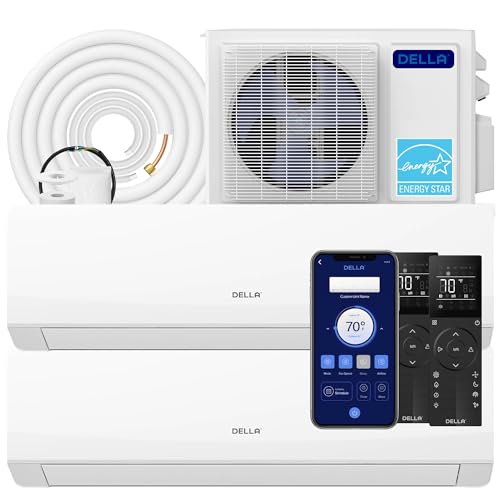
DELLA 18K BTU 2 Zone 7000 + 7000 BTU Mini Split AC & Heat Pump

COSTWAY 20K Dual 2 Zone Mini Split AC/Heating System
A Breakdown Of The Leading Choices
Most dual-zone mini-splits demand a dedicated 230V circuit, which rules out older apartments and converted rentals. The Mountman 12000 BTU runs on standard 110/120V household current, so it sidesteps a major installation barrier for renters and condo owners who can’t easily add a new electrical line.
It covers roughly 750 square feet, making it the right scale for a single large room rather than a true two-room pairing. For shoppers in older buildings without upgraded electrical service, that tradeoff is usually worth it.
Features That Help
- 110/120V operation removes the need for an electrical panel upgrade, which keeps installation simpler in older homes.
- 19 SEER2 inverter efficiency trims long-term electricity costs compared with older single-zone units.
- Four operating modes (cool, heat, dry, fan) plus ECO and sleep settings let you tune comfort across seasons.
- Sleep mode drops noise to about 26 dB, quiet enough for light sleepers in small bedrooms.
- Pre-charged condenser and included installation kit shorten the path to a working system.
Things To Consider
- The 12,000 BTU output suits one large room better than two separate zones, so label-setting expectations matter here.
- 230V systems typically run more efficiently at higher capacities, so heavy daily use in very hot climates may strain the compressor.
Feature Snapshot
Whose Home It Belongs In
Renters, condo owners, and anyone in a pre-1990s building without 230V service who wants quiet, efficient climate control in a single large room.
Swap It Out When
You genuinely need two independently controlled rooms, in which case the Senville Mini Split 28000 BTU brings real dual-zone flexibility.
The Senville Mini Split Air Conditioner Heat Pump sits at the heavy end of this list with 28,000 BTU across two zones, the kind of capacity that handles a main living area and a sizable bedroom simultaneously. Unlike the Mountman reviewed above, this one requires a 230V circuit, so it suits homeowners rather than renters.
For households that want one outdoor unit running two indoor heads with separate temperature settings, the dual-zone design pays off. Smart controls through mobile apps and voice assistants make it friendly to households already deep in a connected-home ecosystem.
Useful Strengths
- 28,000 BTU split across two heads gives real headroom for open-plan living areas plus a separate bedroom.
- Dual-zone design means the living room can stay at 72°F while the bedroom holds at 68°F, without compromise.
- Smart-home compatibility with apps and voice assistants adds scheduling and remote adjustments.
- Energy Star certification signals verified efficiency for long-term operating cost savings.
Trade Offs
- 230V installation requires professional electrical work in most homes, adding to upfront project cost.
- Larger BTU output means longer heat-up and cool-down cycles in mild weather, where smaller units would suffice.
Who Will Love This
Homeowners with two genuinely large rooms to condition, or anyone replacing a noisy window unit plus a portable AC with one cleaner system.
Look Elsewhere When
Your two zones are small bedrooms under 300 square feet each, where the DELLA 7000+7000 BTU pair fits the room scale much better.
The Cooper & Hunter 18,000 BTU 2-Zone Wall Mount Mini Split leans hard into efficiency, with a 22.5 SEER rating that’s well above the federal minimum. It pairs two 12,000 BTU wall-mounted air handlers with a single outdoor condenser, giving you a matched pair rather than mismatched room sizes.
For households that run their cooling system heavily through long Southern summers, the higher SEER rating compounds into real savings on monthly bills. The included smart port adapters and C&H Remote app also let you set each zone independently from a phone.
Positive Takeaways
- 22.5 SEER efficiency is among the highest in this roundup, which matters most for daily-use households in hot climates.
- Two matched 12,000 BTU indoor heads simplify climate planning since each zone handles similar square footage.
- Smart port adapters allow individual zone control through a dedicated app, no extra hub required.
- 230V inverter operation keeps compressor cycling smooth, extending service life in heavy-use scenarios.
Points To Note
- 230V wiring and line-set routing typically call for professional installation, so DIY-first shoppers should budget for a contractor.
- Two equal-capacity heads work best in similarly sized rooms; a small nursery paired with a large living room may leave one zone oversized.
Core Details
Made For
Two-room homes in hot climates where the AC runs most months of the year and electricity bills are a real concern.
Consider Something Else When
You need one small room and one medium room, where the Upstreman 9K+12K BTU pairing matches uneven square footage more cleanly.
The YITAHOME 22 SEER2 system pairs two 9,000 BTU indoor heads with an 18,000 BTU outdoor condenser, covering roughly 800 square feet across two zones. Compared with the Cooper & Hunter reviewed earlier, this one drops the efficiency rating slightly (22 SEER2 vs 22.5 SEER) but adds full Wi-Fi and Alexa integration out of the box.
For households already running Alexa routines, voice control over each zone turns climate into a hands-off part of the day. ETL and AHRI certifications also signal verified performance rather than just spec-sheet claims.
The Upside
- Wi-Fi and Alexa compatibility let you adjust zones through voice commands or scheduled routines.
- 22 SEER2 inverter efficiency holds operating costs down for daily-use households.
- Two equal 9,000 BTU heads work well for two small-to-medium rooms with similar cooling needs.
- Heat pump operation extends the system’s usefulness into cold-weather months, not just summer.
Honest Caveats
- 208-230V power requirement means older homes need electrical work before installation.
- Two 9,000 BTU heads may run short in a single very large room, so room sizing matters.
Right Fit For
Smart-home enthusiasts with two similar-sized rooms, such as a home office and guest bedroom, who want hands-free climate control.
Reach For A Different Pick When
You have one large room and one small one, where the Upstreman 9K+12K BTU split sizes the heads to the rooms instead of forcing a compromise.
The Upstreman 2 Zone Mini Split with Heat Pump takes a practical approach that most competitors skip: a 9,000 BTU head for a smaller room and a 12,000 BTU head for a larger one, both fed by a single 20,000 BTU outdoor condenser. For a classic bedroom-plus-living-room layout, that asymmetry removes the overcooling problem you’d hit with matched heads.
Independent zone control covers separate on/off, temperature, fan speed, and mode settings per room, with 4-way air swing and a 24-hour timer for set-and-forget comfort.
Practical Pluses
- Mismatched 9K+12K head sizing matches real-world room combinations, like a bedroom and a living room, more accurately than equal pairs.
- 23 SEER2 efficiency rating is the highest in this roundup, which helps if your system runs most of the year.
- 4-way air swing distributes conditioned air more evenly across longer wall runs.
- Sleep mode and quiet operation make the smaller head a comfortable fit for light sleepers.
Some Limits To Know
- 230V installation typically requires a licensed HVAC or electrical contractor.
- The 20,000 BTU outdoor unit is over-specced for two small bedrooms, so excess capacity means more upfront cost than a smaller pair would carry.
Feature Card
Best Suited To
Households with one small room and one medium room, especially a primary bedroom and main living area with different comfort needs.
A Better Fit Elsewhere
Two rooms of similar size, where the YITAHOME 9K+9K pair keeps the outdoor unit capacity more proportional to the actual load.
The DELLA 18K BTU 2 Zone system runs two small 7,000 BTU indoor heads off one 18,000 BTU condenser, designed for rooms up to about 600 square feet total. Compared with the larger pairings reviewed above, this one targets a specific layout: two small bedrooms or a bedroom plus a small office.
Energy Star certification and 22 SEER2 efficiency keep the operating profile lean, and the 16.4-foot pre-charged line set covers most standard installations without extra refrigerant work.
Notable Upsides
- Two compact 7,000 BTU heads are the right size for small bedrooms, where oversized units would short-cycle and waste energy.
- Energy Star certification and 22 SEER2 efficiency mean verified low operating costs.
- Wi-Fi and voice control add scheduling without requiring a separate smart-home hub.
- Pre-charged 16.4-foot line set simplifies installation in most single-story layouts.
Points To Keep In Mind
- The self-cleaning function is not supported on this model, so filter maintenance falls on you.
- Two 7,000 BTU heads will struggle in any room above roughly 350 square feet, so room measurements matter.
Quick Technical Notes
Who Should Grab It
Two-bedroom households where each room stays under 350 square feet and energy efficiency matters more than raw cooling power.
Skip It When
One of your zones is a larger living space, in which case the COSTWAY 20K system’s higher capacity handles a real common area.
The COSTWAY 20K Dual 2 Zone Mini Split AC/Heating System rounds out this list with a 23 SEER2 rating and 4D swing airflow, a combination aimed at households that want solid efficiency without stepping up to the largest capacity. The dual-zone design with 20,000 BTU total handles a medium living room and a bedroom together without strain.
Where some systems in this price band feel stripped down, this one retains 4D air swing for even room coverage. For most two-room setups under 1,000 square feet combined, it lands in a comfortable middle ground.
Practical Advantages
- 23 SEER2 efficiency keeps electricity use modest even with daily summer operation.
- 4D swing airflow distributes conditioned air more evenly across wider rooms than fixed-direction louvers.
- Dual-zone independence lets each room hold its own temperature without compromise.
- 20,000 BTU total capacity covers two medium rooms without oversizing for smaller bedrooms.
Where It May Fall Short
- 230V installation typically requires a licensed professional, adding to the overall project cost.
- Larger open-plan spaces above 1,200 square feet combined would need a higher-capacity system like the Senville 28,000 BTU.
At A Glance
Perfect Match For
Mid-size households with one medium living area and one bedroom, where balanced efficiency and even airflow matter more than maximum capacity.
Not Your Match When
You need genuine whole-home coverage, in which case the Senville Mini Split 28000 BTU carries the headroom that mid-tier systems leave on the table.
What To Weigh Before Choosing Your 2 Zone Mini-Splits
Sizing Each Zone To The Room
BTU ratings (British Thermal Units, a measure of cooling and heating capacity) tell you how much heat a system can move per hour, and matching that number to actual room square footage is the first decision. A 7,000 BTU head handles a 300-square-foot bedroom; a 12,000 BTU head covers closer to 550 square feet. Oversized heads short-cycle and waste energy, while undersized heads run constantly without ever hitting the set temperature. Measure each room before browsing, and resist the temptation to round up just for safety.
Voltage And Electrical Access
Most dual-zone mini-splits run on 208-230V, which means a dedicated circuit and often a panel upgrade in older homes. The Mountman reviewed above is the rare exception at 110/120V, which is why it earns a place for renters and pre-1990s buildings. If your electrical panel is already near capacity, factor in the cost of a subpanel or line run before committing to a 230V system.
Efficiency Ratings And Long-Term Costs
SEER2 (Seasonal Energy Efficiency Ratio 2, the current federal standard for measuring AC efficiency over a typical cooling season) ratings above 20 mean meaningfully lower monthly bills in hot climates where the system runs most of the year. The difference between a 19 SEER2 and a 23 SEER2 system compounds over a decade of summer operation. In mild climates with short cooling seasons, the upfront savings of a lower-SEER unit often outweigh the efficiency premium.
Smart Features And Daily Convenience
Wi-Fi and voice assistant support turn climate control into something you adjust once and forget. Households already using Alexa or Google Home routines get the most out of these integrations, especially for scheduling setbacks at night or while away. For households that prefer a simple remote and a wall-mounted controller, the smart features are nice to have rather than essential.
Key Considerations Across These Picks
Pitfalls Shoppers Hit
The most common mistake is sizing both heads the same when the rooms are different. Equal-capacity pairs work fine in twin bedrooms but waste energy in a bedroom-plus-living-room combination. Another frequent misstep is forgetting the electrical work: 230V systems often need a new circuit run from the panel, and that cost can rival the equipment itself. Always measure the line-set distance between indoor and outdoor locations before ordering, since pre-charged kits ship with fixed lengths.
When Paying More Pays Off
Higher SEER2 ratings, like the 23 SEER2 on the Upstreman and COSTWAY picks, cost more upfront but earn that back in households that run cooling eight or more months a year. Premium build quality also tends to mean quieter compressors, longer service intervals, and more reliable heat-pump performance below freezing. For light-use households in mild climates, the efficiency premium rarely pays back, so a mid-tier 19-20 SEER2 system is the smarter spend.