
Shopping for a 1.5 HP pool pump often means sorting through a wall of similar-looking models that promise the world. The right choice depends on your pool’s volume, plumbing distance, and how often you run the system. The wrong pump either wastes energy moving more water than needed, or struggles to keep up during peak summer use. This roundup focuses on options that pair a 1.5 HP motor with practical flow rates, dual-speed flexibility, and build details that hold up across a few seasons of regular service.
A Side-By-Side Look

Replacement Pool Pump Basket Cover for Splapool Pureline Deluxe

Aquastrong Riptide 3 HP Dual-Speed Pool Pump

Aquastrong Riptide 1.5 HP Dual-Speed Pool Pump

VIVOHOME 1.0 HP 5280 GPH Above-Ground Pool Pump
Aquastrong Riptide 2 HP Dual-Speed Pool Pump
Aquastrong Riptide 2 HP Single-Speed Pool Pump
The Picks, Examined More Closely
A cracked or missing pump lid is a small problem that turns into a big headache fast, since the basket sits exposed to debris and the seal can no longer hold prime. This aftermarket cover fits the Splapool Pureline Deluxe and a long list of cross-referenced part numbers, including 47252772, AC81361, NEP2134, and P012728CR. Owners with aging Pureline or Vivo Home HBP1500 II pumps find it a practical swap when the original plastic warps from sun exposure.
It is a niche item, and the rest of this list focuses on full pump replacements, so consider this a fix-it-first option before stepping up to a new unit.
Practical Advantages
- Wide cross-compatibility across Splapool, Pureline, Blue Wave, and related models
- Restores the debris-catching seal that a warped lid can no longer provide
- Costs far less than a full pump replacement when the motor still runs fine
Things To Consider
- Confirmed fit only for the listed part numbers, so double-check your pump model before ordering
Who Will Love This
Homeowners with a still-functional Splapool or Pureline pump whose lid has cracked, warped, or gone missing.
Where Another Pick Suits Better
Step up to the Aquastrong Riptide 1.5 HP Dual-Speed Pool Pump when the motor itself is failing or the pool has outgrown the original pump’s flow.
When the pool is large, the plumbing runs long, or a water feature demands real pressure, a 3 HP motor stops being overkill and starts being necessary. The Aquastrong Riptide 3 HP pushes up to 10,032 GPH on high and drops to 4,755 GPH on low for quieter daily circulation. The pure copper motor is a meaningful upgrade over aluminum windings, since copper handles heat better and tends to last longer under continuous summer duty.
Like the smaller Riptide models further down this list, it self-primes and ships with a filter basket, so installation stays in DIY territory for anyone comfortable with basic electrical work. The 220V requirement means you will need the right circuit, which is worth budgeting into the project before clicking through.
The Good Stuff
- 10,032 GPH peak flow handles large in-ground pools and extended plumbing runs
- Pure copper motor resists heat buildup during long summer cycles
- Dual-speed switching lets you save energy during routine filtration hours
Trade Offs
- 220V wiring may require a dedicated circuit or professional hookup
- Overkill for small above-ground pools where the 1.5 HP or VIVOHOME picks would suffice
Key Specs
Best Suited To
Owners of large in-ground pools who want the headroom of a 3 HP motor and the energy savings of a low-speed setting.
Consider Something Else When
Pick the Aquastrong Riptide 1.5 HP Dual-Speed Pool Pump for smaller pools where this model’s flow would be wasted.
For most mid-size backyard pools, 1.5 HP is the sweet spot between the 1 HP workhorses and the 3 HP heavy hitters. The Aquastrong Riptide 1.5 HP delivers up to 6,604 GPH on high for vacuuming and turnover, then drops to 3,302 GPH on low for long, quiet filtration cycles. That low-speed mode is where the real savings live, since the motor draws noticeably less power during the hours you are not actively cleaning.
The pure copper motor is a shared feature with the larger Riptide models, which means you get the same thermal resilience in a smaller package. Self-priming and a built-in filter basket keep setup simple, though the 220V supply still means a proper outlet or electrician.
The Upside
- 6,604 GPH peak flow suits most above-ground and smaller in-ground pools
- Low-speed mode runs quiet and pulls less power during routine filtration
- Copper motor and self-priming design match the more expensive Riptide siblings
Honest Caveats
- 220V requirement limits placement to where a matching circuit already exists
- Basket needs regular clearing during leaf-heavy seasons to keep flow steady
Made For
Pool owners who want a true dual-speed setup without jumping all the way to 2 or 3 HP.
Look Elsewhere When
The VIVOHOME 1.0 HP Above-Ground Pool Pump is a better match for small pools that do not need the 220V circuit at all.
Sometimes the right answer is the simplest one. The VIVOHOME 1.0 HP runs on a standard 115V household outlet, which removes the electrician step that the 220V Riptide models require. It pushes up to 5,280 GPH at a 42.6 ft max head, which covers most above-ground pools comfortably. The commercial-grade thermoplastic body and thermal overload protection are the kind of details that tend to matter more the longer you own the pump.
The strainer basket sits up front for quick debris clearing, and the ETL and DOE certifications are worth noticing for anyone who cares about verified efficiency and electrical safety. It is the easiest swap on this list for a first-time pump replacement.
What Pays Off
- Plugs into a standard 115V outlet, no special wiring needed
- 5,280 GPH flow suits most above-ground pools up to mid-size
- Thermoplastic housing holds up to heat and typical pool chemicals
Points To Note
- Single-speed design lacks the energy-saving low mode of the dual-speed Riptide pumps
- Performance is best within roughly 10 ft of the pool, so plan placement accordingly
- Seal and impeller benefit from a seasonal check to prevent slow leaks
Feature Snapshot
Perfect Match For
First-time pump shoppers with above-ground pools who want a 115V plug-and-go setup without calling an electrician.
Skip It When
The Aquastrong Riptide 2 HP Dual-Speed Pool Pump fits better for in-ground pools that need more flow and a low-speed mode.
Between the 1.5 HP and 3 HP Riptide models sits the 2 HP version, which lands in the middle on both flow and flexibility. You get up to 8,586 GPH on high for vacuuming and water features, plus 4,427 GPH on low for quieter daily cycles. The shared pure copper motor and self-priming design mean installation and long-term maintenance feel familiar if you have read through the other Riptide reviews above.
For many in-ground pools, 2 HP is the point where flow stops being the bottleneck and starts being a comfortable margin. The 220V requirement still applies, so plan the circuit alongside the purchase.
Well-Handled Touches
- 8,586 GPH peak covers mid-to-large in-ground pools with room to spare
- Dual-speed design cuts power use during routine filtration hours
- Filter basket is easy to access for routine clearing
Worth Noting
- Requires a 220V circuit, which may add electrical work to the project
- Larger and heavier than the 1.5 HP sibling, so plan mounting space
Right Fit For
Homeowners with mid-to-large in-ground pools who want dual-speed savings without stepping up to 3 HP.
Reach For A Different Pick When
The Aquastrong Riptide 3 HP Dual-Speed Pool Pump is the right call for very large pools or long plumbing runs where extra headroom matters.
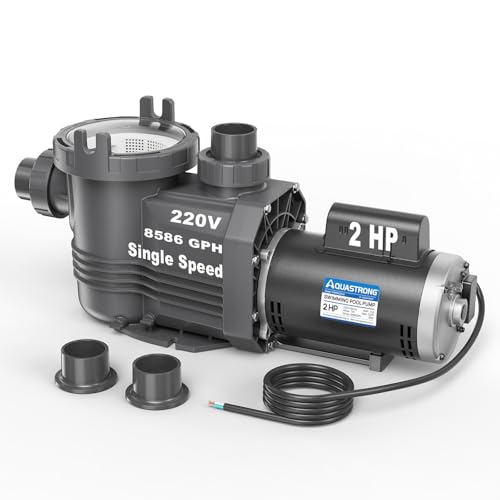
Not everyone wants to think about high and low speeds. This single-speed 2 HP Riptide delivers the same 8,586 GPH flow as its dual-speed sibling, with a pure copper motor and the same self-priming setup. For owners who set a timer and let the pump run its hours without micro-managing speeds, a single-speed design is the path of least resistance.
The trade-off is operational cost. Without a low-speed mode, the motor runs at full power through every cycle, which adds up over a full swim season. If you are willing to pay that premium for simplicity, the rest of the package is solid.
Notable Gains
- Same 8,586 GPH flow as the dual-speed 2 HP sibling
- Pure copper motor and self-priming match the wider Riptide family
- Fewer controls mean less to learn for first-time 220V pump owners
Where It May Fall Short
- No low-speed mode means higher energy use across long daily cycles
- 220V circuit still required for installation
Feature Rundown
Whose Shelf It Belongs On
Pool owners who want straightforward set-and-forget operation and are not focused on long-term energy savings.
Swap It Out When
The Aquastrong Riptide 2 HP Dual-Speed Pool Pump is the smarter pick for anyone willing to switch speeds and trim their electric bill.
What Matters Most When Shopping for a 1.5 HP Pool Pump
Matching Flow to Pool Size
GPH, which stands for gallons per hour, tells you how much water the pump moves in an hour. Most pool pros aim to turn over the full pool volume once every 8 to 10 hours, so a 1.5 HP pump with 6,600 GPH can handle roughly a 25,000-gallon pool at peak. Smaller pools are fine with the VIVOHOME 1.0 HP, while larger in-ground setups benefit from the 2 or 3 HP Riptide models and their higher flow ceilings.
Voltage and Wiring
Voltage shapes the installation as much as it shapes performance. A 115V pump plugs into a normal outlet, which is why the VIVOHOME model is the easiest swap for above-ground owners. A 220V pump, including every Aquastrong Riptide on this list, needs a dedicated circuit. Budget for an electrician if your equipment pad does not already have one in place.
Single-Speed vs. Dual-Speed
A single-speed pump runs at full power every cycle, which is simple but expensive over a full season. A dual-speed pump adds a lower setting for routine filtration, often cutting power use in half during the hours you are not actively cleaning. The Riptide 1.5, 2 HP dual-speed, and 3 HP models all offer this, while the Riptide 2 HP single-speed does not.
Build Quality and Maintenance
A copper motor handles heat better than aluminum windings and tends to outlast them under heavy summer use. Thermoplastic pump housings resist chemical wear, and a strainer basket you can reach without tools makes routine clearing less of a chore. Plan on clearing the basket weekly during leaf season and checking the mechanical seal once a year.
Key Considerations Across These Picks
Where Shoppers Go Wrong
The most common mistake is oversizing. A 3 HP pump on a small above-ground pool just wastes electricity, while a 1 HP pump on a large in-ground pool will struggle to keep the water clear. Match flow to pool volume, and check that your existing circuit matches the pump’s voltage before clicking through.
When Paying More Pays Off
Higher-tier models in this category earn their keep through dual-speed savings, copper motors, and higher flow ceilings that handle larger pools without strain. Owners who run their pump 8+ hours a day see meaningful energy savings from a low-speed mode, and the copper motor upgrade pays back through longer service life. For occasional-use pools, the simpler single-speed or 1 HP options make more sense.
Frequently Asked Questions
How many GPH do I need for my pool?
Aim for a pump that can move your pool’s full gallon volume in 8 to 10 hours. Divide your pool’s gallons by 8, and you have a rough minimum GPH target for peak flow.
Is a 1.5 HP pump enough for an in-ground pool?
For most residential in-ground pools up to about 20,000 gallons, yes. Larger pools or setups with long plumbing runs benefit from stepping up to 2 or 3 HP.
Can I install a 220V pool pump myself?
Experienced DIYers comfortable with electrical work often can, but most homeowners hire a licensed electrician for the dedicated circuit. The pump itself is straightforward, but the wiring is not.
What is the benefit of a copper motor?
Copper windings handle heat better and tend to last longer than aluminum, especially during long summer cycles. That usually shows up as a longer service life rather than day-to-day performance differences.
How often should I clean the pump basket?
Weekly during heavy leaf season, and every two to three weeks during quieter months. A clogged basket forces the motor to work harder and reduces flow across the whole system.
Final Take
Your pool’s size, your existing wiring, and how often you run the pump each day will narrow this list down fast. Small above-ground pools get along fine with the VIVOHOME 1.0 HP, while most in-ground setups land on one of the Aquastrong Riptide options. Pick the flow that matches your pool, the voltage your circuit supports, and the speed flexibility you will actually use.