
Keeping an in-ground pool clean means the pump never really gets a day off, and the right horsepower, flow rate, and motor type quietly shape your water bill and your weekend maintenance. A 1 HP class pump sits in the sweet spot for many residential pools, balancing turnover rate with reasonable electrical draw. This roundup walks through nine options built for in-ground setups, covering single-speed, dual-speed, and variable-speed models so you can match the pump to the pool, not the other way around.
An Overview Of The Picks

Hayward Super Pump Inground Pool Pump 1 HP

Aquastrong Riptide 3 HP Dual-Speed Pool Pump

Aquastrong Riptide 1.5 HP Dual-Speed Pool Pump
VARMINPOOL 1.8 HP Variable Speed Pool Pump

VARMINPOOL 2.5 HP Variable Speed Pool Pump

Harris ProForce 1 HP Above Ground Pool Pump
Aquastrong Riptide 2 HP Dual-Speed Pool Pump
Aquastrong Riptide 2 HP Single-Speed Pool Pump
Aquastrong Riptide 1.5 HP Single-Speed Pool Pump
What Each Pick Brings To The Table
The Hayward Super Pump is the pump many pool pros reach for first when a homeowner asks for a reliable single-speed 1 HP unit. Its heavy-duty motor and airflow ventilation are built around quieter, cooler operation than older single-speed designs, which matters if your equipment pad sits near a patio or bedroom window. The service-ease design uses a 4-bolt lid that swings open for quick access to the strainer basket and internal components, so routine cleaning takes minutes instead of feeling like a repair job.
For most medium-head in-ground pools with standard plumbing runs, this model has been a go-to for years. Hayward is a recognized name in the pool industry, and parts availability is generally strong if a seal or basket ever needs replacement. It runs on standard 115/230V wiring, so most existing pads can accept it without rewiring.
The Practical Payoff
- Heavy-duty motor with airflow ventilation that reduces operating noise compared to older single-speed pumps.
- 4-bolt service-ease lid gives quick access to the strainer basket, cutting routine cleaning time.
- Established brand with widely available replacement parts for long-term ownership.
- Handles medium-head in-ground pools and attached spas within its rated flow range.
Worth Noting
- Single-speed design runs at full power continuously, so ongoing electricity use runs higher than variable-speed alternatives.
- Some users report the strainer basket lid O-ring needs occasional lubrication to stay sealing properly.
Key Specs
Who It Suits Best
Homeowners with a standard medium-head in-ground pool who want a proven, widely serviced single-speed workhorse.
Look Elsewhere When
Energy-conscious pool owners should look at the VARMINPOOL 1.8 HP Variable Speed Pool Pump, which uses inverter technology to cut long-term running costs.
This Aquastrong Riptide entry is a step above the 1 HP category, but it earns its place here for larger in-ground pools with water features or attached spas that demand real flow. The 3 HP pure copper motor runs on 220V and switches between a high mode pushing up to 10,032 GPH and a low mode that moves around 4,755 GPH. That dual-speed design lets you run the lower setting for quiet daily circulation and ramp up only when vacuuming, running a heater, or pushing water through a waterfall.
Compared to the Hayward Super Pump above, this is a noticeably more powerful machine with a higher electrical draw. It is best suited for pools where single-speed 1 HP output would feel underwhelming. The pure copper motor construction is a nice touch for thermal efficiency and longevity, and the unit is self-priming with a built-in filter basket to catch debris before it reaches the impeller.
The Value In It
- Up to 10,032 GPH on high speed handles large pools, spas, and water features without struggling.
- Dual-speed operation gives you a quieter, more efficient low mode for routine circulation.
- Pure copper motor helps with heat dissipation and long-term durability under load.
- Self-priming design with a debris-catching filter basket simplifies startup and protects the impeller.
Trade Offs
- Requires a 220V electrical circuit, which may need professional installation on older pads.
- Overkill for small or average in-ground pools where 1 HP flow is already sufficient.
- Heavier and bulkier than the smaller Aquastrong Riptide models, so plan equipment-pad space.
Made For
Owners of large in-ground pools with water features or spas who need serious flow on demand.
Consider Something Else When
Smaller in-ground pools with standard plumbing are a better match for the Aquastrong Riptide 1.5 HP Dual-Speed Pool Pump, which delivers similar efficiency benefits at a more appropriate flow level.
Stepping down from the 3 HP flagship, the Aquastrong Riptide 1.5 HP dual-speed model hits a useful middle ground for many residential in-ground pools. The high mode pushes up to 6,604 GPH, while the low mode settles around 3,302 GPH for quiet daily filtering. That low-speed setting is where the real ownership benefit shows up, since the pump spends most of its life on that mode, and halving the RPM can meaningfully cut kilowatt-hour use compared to a single-speed 1 HP unit running flat out.
The pure copper motor and self-priming design mirror the larger Aquastrong models, so maintenance habits stay consistent across the lineup. The 220V requirement is worth flagging up front, since some older pads are wired for 115V only. For pools that already run 220V equipment, the swap is straightforward.
Strong Points
- Low-speed mode at roughly 3,302 GPH keeps routine circulation quiet and more energy-efficient.
- Pure copper motor supports heat management during long filter cycles.
- Self-priming startup with a built-in debris basket protects the impeller from leaf and grit damage.
- Flow range suits mid-size in-ground pools that feel under-served by a 1 HP single-speed pump.
Honest Caveats
- 220V wiring requirement may add installation cost if your existing pad is 115V only.
- Not the most efficient option on this list, since the variable-speed VARMINPOOL models can go even lower for daily circulation.
Feature Snapshot
Best Suited To
Mid-size in-ground pool owners who want dual-speed efficiency without oversizing to a 2 or 3 HP unit.
A Better Fit Elsewhere
Pool owners focused purely on long-term energy savings should consider the VARMINPOOL 1.8 HP Variable Speed Pool Pump, which offers finer RPM control than a two-speed design.
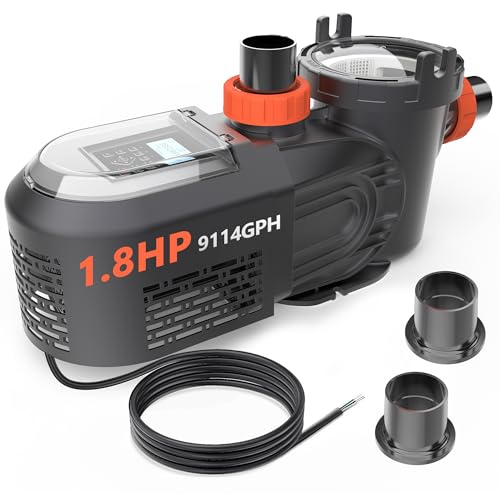
Variable-speed pumps are where the in-ground pool industry has been heading, and the VARMINPOOL 1.8 HP model brings that technology into the 1 HP class conversation. An inverter-driven permanent magnet motor adjusts speed across a range from roughly 1,200 to 4,000 RPM, so the pump can run as low as needed for daily filtration and ramp up only when vacuuming or running a heater. Maximum flow tops out around 9,114 GPH, which is more than enough for most small to mid-size in-ground pools.
Compared to the Aquastrong Riptide dual-speed picks above, this is a finer-grained approach. Instead of two preset speeds, you get continuous adjustment, which is where the meaningful energy savings come from. It also handles saltwater setups, so chlorinated and saltwater in-ground pools are both compatible. The trade-off is a higher upfront cost and a steeper learning curve for programming.
Well-Handled Touches
- Inverter-driven motor adjusts RPM continuously, cutting energy use during long filter cycles.
- Permanent magnet motor design supports cooler, more efficient operation than older induction motors.
- Saltwater compatibility widens the pool types this pump can serve.
- Up to 9,114 GPH at peak handles small to mid-size in-ground pools comfortably.
Points To Note
- Programming the speed schedule takes some trial and error for first-time variable-speed owners.
- Runs on 220V, so older 115V pads will need electrical work before installation.
- Upfront cost runs higher than the single-speed and dual-speed Aquastrong models.
Perfect Match For
Energy-conscious in-ground pool owners, especially those running saltwater systems, who want to dial in filtration speed.
Skip It When
Shoppers who want simple on-and-off operation are better served by the Aquastrong Riptide 1.5 HP Single-Speed Pool Pump, which avoids programming entirely.
The larger VARMINPOOL 2.5 HP variable-speed pump stretches beyond the strict 1 HP category, but it earns consideration for in-ground pools that want serious flow plus variable-speed control. Peak flow reaches around 10,567 GPH, and the permanent magnet motor with precision impeller design aims to keep that flow efficient rather than wasteful. A programmable timer, rain cover, and large filter basket round out the package, which is more inclusive than most competitors at this level.
For homeowners thinking about pool automation, a programmable pump like this slots in naturally alongside a salt cell or automated valve. The speed range mirrors the smaller VARMINPOOL 1.8 HP model, so the difference is mostly headroom. Depending on your pool’s plumbing length and vertical lift, you may find the extra horsepower either essential or simply unused.
Real Benefits
- Programmable timer automates daily speed schedules without manual intervention.
- Large filter basket extends the time between manual cleanings, helpful in leafy yards.
- Up to 10,567 GPH covers larger in-ground pools and attached spa combinations.
- Rain cover included, useful for outdoor equipment pads with limited shelter.
Worth Bearing In Mind
- Premium feature set comes with a higher sticker price than the dual-speed Aquastrong models.
- Overkill for modest in-ground pools where 1 HP flow is already adequate.
- 220V wiring and a heavier physical footprint require solid pad space and electrical capacity.
Who Will Love This
Homeowners with larger in-ground pools or automation setups who want full control over pump scheduling.
Another Choice May Suit
Smaller in-ground pools get plenty of headroom from the Aquastrong Riptide 2 HP Dual-Speed Pool Pump, which offers much of the same flow at a lower tier.
Strictly speaking, the Harris ProForce 1 HP is marketed as an above-ground pump, but the same qualities that suit smaller above-ground pools translate well to compact in-ground installations. It runs on standard 115V, so no special electrical work is needed, and the single-speed design keeps controls to a simple on-and-off switch. The thermoplastic shell holds up against seasonal weather, and the stainless steel motor shaft helps with corrosion resistance over the long run.
Total horsepower is rated at 0.9 THP (total horsepower), which is slightly below a true 1 HP figure. For modest in-ground pools with short plumbing runs, that headroom is rarely an issue. Where it may feel limiting is on pools with elevated equipment pads, long pipe runs, or heavy water features that demand more pressure.
Everyday Advantages
- 115V operation lets you plug into a standard outlet, no electrician required.
- Stainless steel motor shaft resists corrosion in humid pool environments.
- Thermoplastic shell tolerates seasonal weather swings on outdoor pads.
- Simple single-speed operation means no programming or schedule to manage.
A Few Limitations
- Rated at 0.9 THP, so flow falls a little short of a true 1 HP pump under heavy demand.
- Single-speed design runs at full power continuously, with no low-mode energy savings.
- Not ideal for elevated equipment pads or pools with long plumbing runs.
Quick Facts
Right Fit For
Smaller in-ground pools and DIY-friendly installations that need 115V plug-and-play simplicity.
Reach For A Different Pick When
Larger in-ground pools with attached features are better served by the Hayward Super Pump Inground Pool Pump 1 HP, which is purpose-built for in-ground duty cycles.
The 2 HP dual-speed Aquastrong Riptide splits the difference between the 1.5 HP and 3 HP models in the same family. High-speed flow climbs to 8,586 GPH, while the low-speed mode sits near 4,427 GPH, which is enough for routine circulation in most mid-to-large in-ground pools. The pure copper motor and self-priming design with a built-in filter basket mirror the rest of the Riptide lineup, so switching between Aquastrong models is mostly about flow headroom.
Where this pump feels well-matched is in pools with moderate water features, raised spas, or slightly longer plumbing runs that the 1.5 HP version might struggle with on high demand. Compared to the VARMINPOOL 2.5 HP variable-speed pick above, you give up fine-grained RPM control in exchange for simpler two-mode operation.
What Makes Sense
- Up to 8,586 GPH handles mid-to-large in-ground pools and modest water features.
- Low-speed mode around 4,427 GPH keeps daily filtration quieter and more efficient than single-speed models.
- Pure copper motor and self-priming startup carry over from the rest of the Riptide family.
- Filter basket traps debris before it reaches the impeller, reducing wear.
Less-Strong Areas
- 220V wiring is required, which may add installation cost on 115V pads.
- Still less efficient than true variable-speed models during long low-flow cycles.
Whose Shelf It Belongs On
Mid-to-large in-ground pool owners who want headroom for features without jumping to a 3 HP unit.
Swap It Out When
Energy-focused owners should consider the VARMINPOOL 1.8 HP Variable Speed Pool Pump, which offers continuous RPM adjustment beyond the two preset speeds.
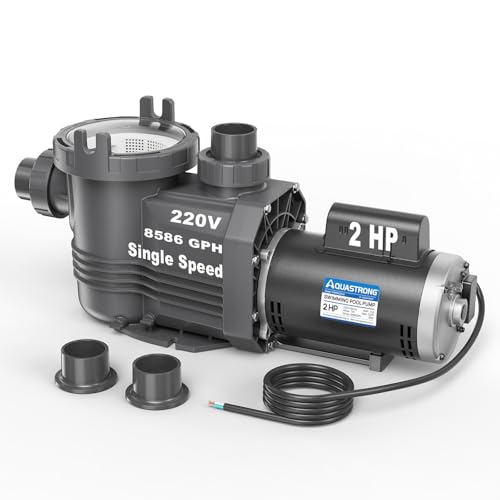
The single-speed sibling to the 2 HP dual-speed model above is worth considering if you prefer set-and-forget operation over mode switching. Flow tops out at 8,586 GPH from a 220V pure copper motor, and the self-priming design with built-in filter basket keeps startup and routine maintenance straightforward. For pool owners who never touch their pump settings once installed, that simplicity has real value.
Compared to the dual-speed version, the trade-off is straightforward: you lose the low-speed efficiency mode, and the pump runs at full power whenever it is on. If your utility rates are low or your pool runs only a few hours a day, the difference in annual kilowatt-hours may be modest. For pools running eight or more hours a day, the dual-speed variant usually pays for itself over time.
The Upside
- Up to 8,586 GPH supports mid-to-large in-ground pools and steady filtration cycles.
- Pure copper motor and self-priming design with a debris-catching filter basket.
- Simple single-speed operation, no schedules or mode-switching to manage.
- Build quality mirrors the rest of the Riptide family for consistent ownership experience.
Potential Sticking Points
- Single-speed operation means higher long-term energy use than dual-speed or variable-speed options.
- 220V wiring required, so older 115V pads need electrical work.
Built With In Mind
Pool owners who want strong, simple, set-and-run flow without programming or mode management.
Where A Sibling Pick Shines
The Aquastrong Riptide 2 HP Dual-Speed Pool Pump is the obvious alternative when long filter cycles make a low-speed mode worthwhile.
Rounding out the list, the Aquastrong Riptide 1.5 HP single-speed model delivers up to 6,604 GPH from a pure copper 220V motor. It carries the same self-priming design and filter basket as its Riptide siblings, so the maintenance routine stays familiar across the lineup. For smaller in-ground pools where a 1 HP single-speed would feel underpowered but a dual-speed unit seems like overkill, this lands in a useful middle.
Compared to the Hayward Super Pump that opened the list, this Aquastrong is a step up in flow but lacks the long service track record and broad parts ecosystem Hayward has built. Depending on how much that matters to you, the trade-off can read either way. For first-time pool owners, Hayward’s service network may feel more reassuring; for owners comfortable with self-serve troubleshooting, the Aquastrong flow advantage is appealing.
Positive Points
- Up to 6,604 GPH covers small to mid-size in-ground pools with confident turnover.
- Pure copper motor construction for steady thermal performance under load.
- Self-priming startup with built-in filter basket simplifies installation and protects the impeller.
Points To Keep In Mind
- Single-speed operation runs at full power, raising long-term energy use compared to dual or variable-speed models.
- 220V wiring requirement may add installation cost on pads wired for 115V only.
- Newer brand presence in the U.S. market compared to long-established names like Hayward.
Feature Card
Who Should Grab It
Smaller in-ground pool owners who want stronger flow than 1 HP without committing to a 2 HP or variable-speed model.
Where Another Pick Suits Better
The Aquastrong Riptide 1.5 HP Dual-Speed Pool Pump is a better match when long daily filter cycles make a low-speed mode financially attractive.
Matching A Pump To Your Pool Setup
Choosing a 1 HP class pool pump really comes down to three things: your pool’s size and hydraulic demand, the electrical service on your equipment pad, and how much you care about long-term energy use. A small to mid-size in-ground pool with straightforward plumbing rarely needs more than a 1 to 1.5 HP pump, and oversizing can actually cause problems by forcing the pump to throttle back against closed valves, which wastes energy and stresses seals.
Horsepower And Flow
Horsepower on its own is a rough proxy for capability. Two pumps with the same horsepower rating can produce very different flow rates depending on impeller design, motor efficiency, and internal hydraulics. GPH (gallons per hour) is the more useful number, because it tells you how much water actually moves through your filter per hour. As a rule of thumb, your pool’s total gallon capacity divided by the pump’s GPH gives you a turnover time, and most residential pools aim for one full turnover every eight to twelve hours.
Single-Speed Vs Dual-Speed Vs Variable-Speed
Single-speed pumps are the simplest and least expensive up front, but they run at full power every minute they are on. Dual-speed models add a low mode that drops RPM dramatically for daily filtration, which is where meaningful kilowatt-hour savings show up. Variable-speed pumps go a step further with continuous RPM adjustment, letting you match pump output to the actual job: low for filtering, medium for heating, high for vacuuming. The upfront cost rises with each step, but electricity savings can pay back the difference over several seasons.
Voltage And Installation
Many of the pumps in this roundup require 220V wiring, while a few, like the Harris ProForce 1 HP, run on standard 115V outlets. If your existing equipment pad is wired for 220V already, you have more options. If it is not, factor the cost of an electrician into your decision, since a new circuit and breaker can add up. Physical size and weight also matter: variable-speed and high-horsepower models tend to be heavier, so your pad needs to support them.
Practical Realities Of Living With A Pool Pump
Beyond the spec sheet, a few practical realities shape daily ownership. Noise levels matter if your equipment pad sits near a window or outdoor living space, and variable-speed models generally run quieter since they spend most of their time at low RPM. Filter basket access is another small but meaningful detail: pumps with tool-free or 4-bolt lid access make routine cleaning faster, and debris-catching baskets protect the impeller from leaf and grit damage.
Common Buying Mistakes
The most common slip-up is sizing a pump by horsepower label alone rather than by your pool’s actual hydraulic demand. A 1 HP pump with strong GPH can outperform a 2 HP pump with poor hydraulic design, and oversizing leads to wasted energy and accelerated wear on seals and bearings. Another trap is ignoring voltage requirements until installation day, when you discover your pad is 115V and the pump you want is 220V. Measure twice, including the electrical panel, before committing.
When Spending More Pays Off
The jump from a basic single-speed pump to a variable-speed model is one of the few pool upgrades that genuinely pays back through energy savings. A variable-speed pump running most of the day at low RPM can use a fraction of the electricity of a single-speed pump running at full power, and over several seasons that difference adds up. If your pool runs eight or more hours a day, or your utility rates run high, the upgrade is usually worth it. For pools that run only a few hours a day at modest rates, a quality single-speed or dual-speed pump is often the smarter financial call.
Frequently Asked Questions
How Do I Know If 1 HP Is Enough For My In-Ground Pool?
A 1 HP pump generally handles small to mid-size in-ground pools with standard plumbing. For larger pools, pools with water features, or pools with elevated equipment pads, stepping up to 1.5 or 2 HP gives you more headroom without oversizing.
Are Variable-Speed Pumps Really Worth The Extra Cost?
For pools running long daily filter cycles, variable-speed pumps usually pay back their higher upfront cost through lower electricity use. For pools running only a few hours a day at modest rates, the savings take longer to materialize and a single-speed or dual-speed pump may make more financial sense.
What Is The Difference Between 115V And 220V Pool Pumps?
Voltage refers to the electrical supply the pump needs. 115V pumps plug into standard household outlets, while 220V pumps require a dedicated higher-voltage circuit. Many stronger pumps run on 220V because it delivers power more efficiently to the motor.
Can I Install A Pool Pump Myself?
Some owners handle installation on 115V pumps with existing pad wiring, especially with above-ground or compact in-ground setups. For 220V models, new electrical circuits, or major plumbing changes, a licensed electrician or pool professional is usually the safer call.
How Often Should I Clean The Pump Strainer Basket?
Cleaning the strainer basket every one to two weeks during heavy use is a common practice, with less frequent cleaning in cooler months when debris drops off. A quick visual check weekly during peak season keeps flow consistent and protects the impeller from clogging.
The Takeaway
The right 1 HP class pool pump depends on your pool’s size, your equipment pad’s electrical service, and how much you value energy savings over upfront cost. Hayward remains a proven workhorse for standard installations, the Aquastrong Riptide lineup offers strong value across horsepower tiers, and the VARMINPOOL variable-speed models deliver meaningful long-term efficiency. Match the pump to the pool, and the rest of the season tends to take care of itself.