
A 3-inch caster wheel hits a sweet spot most people overlook. It’s small enough to slide under a low workbench, strong enough to roll a loaded tool cart across a garage floor, and quiet enough to keep an apartment peaceful. The trouble is, “3-inch caster” sounds simple until you start comparing plate mounts versus threaded stems, polyurethane treads versus molded rubber, and braking systems that either lock both wheel and swivel or just the wheel.
This guide is for hands-on folks: garage tinkerers, small-shop woodworkers, and anyone tired of dragging heavy furniture across a room. You’ll find eight solid sets examined side by side, with honest notes on load ratings, tread materials, and the little details that matter after the box is open.
A Quick View Of The Lineup

POWERTEC 3 Inch Swivel Caster Wheels Set of 4 (17206)

TABKEER 3 Inch Industrial Swivel Caster Wheels With Brake (1600 lbs)

BOSGEOT 3 Inch Casters Set of 4 With Brake
Apllamo 3-Inch Lock Casters Set of 4 (2,000 lbs)

NISUSK 3 Inch Heavy Duty Stem Casters With Brake (3/8″-16 x 1-1/2″)

BOSGEOT 3 Inch Casters Set of 4 With Brake (120 lb/wheel)
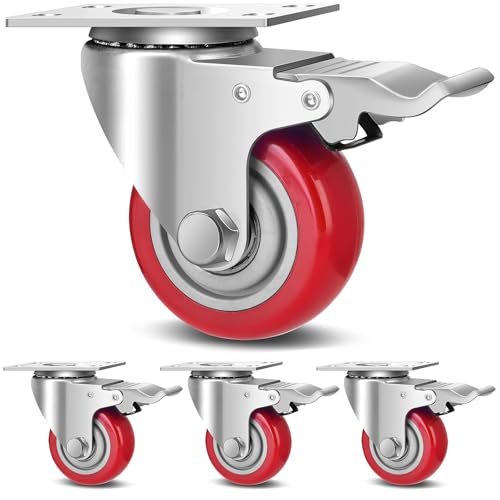
TABKEER 3 Inch Industrial Swivel Caster Wheels With Brake (1600 lbs)
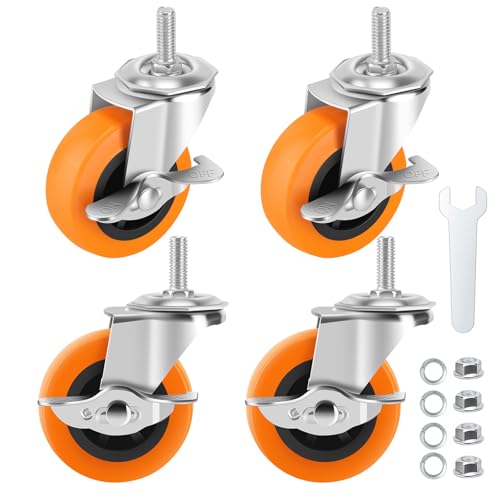
WHARSTM 3 Inch Locking Swivel Threaded Stem Casters Set of 4
The Picks, Examined More Closely
POWERTEC built these casters for the kind of workbench that gets dragged across a garage floor weekly. The polyurethane (PU) tread rolls quietly over concrete and sealed wood, and the 360-degree swivel head makes repositioning a loaded bench easier than wrestling it on rubber pads. For most home workshops, that’s the trade-off that wins: less noise, smoother starts, and no scuffing on a painted floor.
The set arrives as four swivel casters with no brake, which keeps the design simple and the price accessible. Plate mounting means drilling four holes per caster, but once installed these stay put. They’re a sensible starting point compared to the heavier plate-mount sets later in the list, especially if load ratings under 200 lb per wheel match your setup.
Useful Strengths
- Polyurethane tread stays quiet on concrete and finished floors, a real plus in shared living spaces.
- Full 360-degree swivel makes tight garage corners workable without lifting one end of the bench.
- 160 lb per wheel capacity suits most hobby workbenches, tool stands, and rolling carts.
- Solid plated steel yoke holds shape under repeated side loads, which is what kills cheaper casters over time.
- Plate-mount design gives a rigid connection that won’t loosen with vibration like some stem mounts.
Points To Keep In Mind
- No brake means the bench will drift on sloped garage floors, something to plan around.
- Plate mounting requires accurate drilling; sloppy holes lead to wobbly casters that never seat right.
Right Fit For
Home workshop owners building a movable workbench, cart, or low rolling table where quiet rolling matters more than maximum load.
Look Elsewhere When
You need a brake or higher load capacity; the TABKEER 3 Inch Industrial Swivel Caster Wheels With Brake is the more capable plate-mount option.
This TABKEER set is the workhorse tier of the list, with a 1,600 lb total load capacity across four casters. The total-locking brake locks both the wheel rotation and the swivel head, which matters on sloped shop floors where a half-locked caster still pivots and walks. The double-bearing (two sets of ball bearings inside the hub) design keeps rolling resistance low even under load.
Compared to the POWERTEC set above, this is a noticeable step up in raw strength and adds a brake, but the PU tread feels similar on the floor. Plate mounting, polyurethane wheels, and 360-degree swivel are all present. The heavier rating and brake system make it the right call for saw tables, trailer-mounted workstations, and stage rigs that need to stay put once parked.
A Favorable Mix
- 1,600 lb total capacity handles heavy machinery bases, dense tool cabinets, and rolling workstations.
- Total-locking brake secures both wheel and swivel, so parked equipment won’t drift on shop slopes.
- Double-bearing hub keeps rolling smooth even when fully loaded, reducing push fatigue.
- High-carbon steel yoke resists deformation under sudden impacts or drops at the curb.
Trade-Offs To Consider
- Plate footprint is larger than budget sets, so retrofitting older bases may need new hole patterns.
- Higher per-wheel rating also means more weight to lift if you ever need to remove the caster.
Key Details
Made For
Small-shop pros and serious DIYers running saw tables, mobile workstations, or stage platforms that need both strength and a real parking brake.
A Better Fit Elsewhere
Casual garage tinkerers building a light utility cart; the POWERTEC 3 Inch Swivel Caster Wheels keep things simpler and lighter on the wallet.
BOSGEOT positions this set in the middle of the pack: a 100 lb per wheel rating, galvanized steel yoke, and a brake that locks both wheel and swivel. Galvanizing is a zinc coating that helps the steel resist rust in damp garages and basements, which is where most home casters end up living anyway. The PU tread keeps noise reasonable on tile and sealed concrete.
For a small rolling nightstand, a low planter dolly, or a side table that needs to slide out for cleaning, this is a sensible match. The orange-tinged wheels are easy to spot in a cluttered drawer, too, which sounds minor until you spend twenty minutes hunting for a caster in a junk bench.
Practical Pluses
- Galvanized steel yoke adds corrosion resistance for damp basements and unheated shops.
- Double-locking brake keeps both wheel and swivel stationary, helpful on slightly sloped floors.
- PU tread rolls quietly across tile, hardwood, and sealed concrete without scuffing.
- Plate mount keeps the caster flush against the base, which looks cleaner under furniture.
A Few Limitations
- 100 lb per wheel is modest; overloading at the load rating leads to bent yokes within months.
- Plate footprint may not match older furniture that used smaller casters.
Best Suited To
Homeowners adding mobility to small furniture pieces, lightweight carts, and planter stands in spaces with mild moisture exposure.
Swap It Out When
You’re rolling a heavier tool cabinet or loaded workshop cart; the TABKEER 3 Inch Industrial Swivel Caster Wheels With Brake handle the weight.
Apllamo goes a different direction with molded rubber tread instead of polyurethane. The difference shows up on rough concrete and slightly uneven garage slabs, where rubber absorbs small bumps that PU tends to transmit as a rattle. The 2,000 lb total capacity is the highest on this list, and the safety double-layer lock stops both wheel rotation and swivel travel when engaged.
Where the earlier POWERTEC set keeps things quiet on smooth surfaces, this Apllamo set trades some of that silence for impact absorption and grip. It’s the right pick for outdoor smoker carts, rough shed floors, and any project that rolls across cracked pavement. Compared to the PU options, you’ll feel a bit more cushion under the load.
Useful Highlights
- Solid molded rubber tread absorbs cracks, gravel, and small debris without transmitting every bump.
- 2,000 lb total capacity covers heavy machinery bases, rolling benches, and dense storage racks.
- Stainless steel external structure resists rust in humid garages and covered patios.
- Safety double-layer lock secures wheel and swivel, important on sloped or uneven ground.
Honest Caveats
- Rubber tread can leave faint marks on some vinyl floors over months of stationary contact.
- Heavier steel structure adds noticeable weight to the base of lighter furniture pieces.
Who Should Grab It
Owners with uneven garage floors, outdoor workspaces, or rolling equipment that needs serious load capacity and impact absorption.
Consider Something Else When
You mainly roll across smooth indoor floors and want the quietest possible tread; the POWERTEC 3 Inch Swivel Caster Wheels deliver that with less weight.
The NISUSK set introduces a different mounting style: a threaded stem (a screw-in shaft that drops into a pre-drilled hole and tightens with a nut) instead of a flat plate. The 3/8″-16 thread at 1-1/2″ long fits many stools, light stands, and shop-built carts where drilling a flat plate pattern is awkward. You drop the stem into a hole, tighten the included nut from below, and you’re rolling.
The 600 lb total capacity is lower than the heavy plate-mount sets, but it’s plenty for mobile shop stands, music gear racks, and lighter utility furniture. The side-locking brake holds the wheel without locking the swivel, which means the caster can still pivot under load. That’s a design choice worth knowing about, especially if your rolling stand sits on a sloped surface.
What It Does Well
- Threaded stem mount avoids drilling a four-hole plate pattern, a real time-saver on existing furniture.
- Steel housing supports repeated loads up to 600 lbs across the set without flex.
- No-noise wheel tread is comfortable in shared workspaces and home offices.
- Side-mounted brake is reachable without crawling under the base to engage it.
Things To Weigh
- Side brake locks only the wheel, not the swivel, so a parked stand can still drift on slopes.
- Stem diameter and length must match your existing hole, so measure twice before ordering.
Key Details
Right Fit For
Makers retrofitting stools, mobile music stands, and shop-built rolling bases that already have a stem socket drilled.
Reach For A Different Pick When
You need a brake that also locks the swivel on a sloped surface; the TABKEER 3 Inch Industrial Swivel Caster Wheels With Brake solve that.
This second BOSGEOT set looks nearly identical to the third pick on paper, but the per-wheel rating climbs to 120 lb. That extra 20 lb per corner is meaningful for workshop carts that occasionally haul a heavier tool box, and it’s a useful upgrade without stepping into the heavier plate-mount price range. Galvanized steel, PU tread, and double-locking brake all carry over.
The honest read is that this is a quiet step up from its 100 lb sibling for shoppers who want a small buffer in load capacity. It still won’t match the 1,600 lb plate-mount sets for serious machinery, but for rolling tool carts, planter bases, and shop-built storage, it lands in a comfortable middle ground.
What Makes Sense
- 120 lb per wheel capacity gives headroom for temporarily heavier loads without overstressing the yoke.
- Double-locking brake secures both rotation and swivel for stable parking.
- Galvanized steel yoke handles damp workshop environments without quick surface rust.
Potential Sticking Points
- Plate mounting requires careful layout to keep the four casters aligned under the base.
- PU tread is still a touch louder on bare concrete than rubber alternatives.
Made For
Budget-conscious workshop owners building rolling tool carts and storage bases that occasionally handle heavier loads than the lightest sets tolerate.
Where Another Pick Suits Better
You regularly move equipment that exceeds 500 lb across the whole base; the Apllamo 3-Inch Lock Casters Set of 4 carry far more weight.
This second TABKEER listing carries the same headline spec: 1,600 lb total capacity, total-locking brake, polyurethane tread, and plate mount. It exists as a separate listing on the retailer, which matters because product details can differ between ASINs even when brand and spec sheet look identical. If the first TABKEER set is out of stock, this one fills the same role without compromise.
For shoppers outfitting a second workbench or a parallel setup in another bay, having an alternate version of a known spec is useful. The build feels comparable to pick two, and the same high-carbon steel yoke and double-bearing hub should hold up to similar shop abuse. Where it earns its place is supply reliability rather than a new feature.
Strong Points
- Matches the 1,600 lb capacity of the other TABKEER set, so a second bench gets the same rating.
- Total-locking brake keeps parked equipment stationary on slight shop floor grades.
- Plate mount provides a rigid four-bolt attachment that resists vibration loosening over time.
Factors To Consider
- Spec overlap with pick two means a side-by-side comparison offers no clear advantage to call out.
- Plate footprint is on the larger side, so verify the mount pattern fits your base before drilling.
Who Will Love This
Shop owners outfitting a second rolling workstation who want the same heavy-duty rating as their primary bench without waiting for restock.
Not Your Match When
You want a tread that absorbs rough outdoor terrain; the Apllamo 3-Inch Lock Casters Set of 4 has a rubber tread better suited to cracked pavement.
WHARSTM rounds out the list with another threaded-stem option, this one running a 3/8″-16 x 1″ shaft, a touch shorter than the NISUSK set. The shorter stem suits bases with thinner walls or pre-drilled sockets that don’t have room for a longer shaft to drop in. The package includes nuts and a wrench, which is a small but useful touch.
Per-wheel rating sits around 100 lb, putting the total capacity near 400 lb when the load is distributed evenly. The side brake is reachable by hand or foot, depending on the height of the rolling base. For mobile plant stands, small equipment carts, and shop-built racks that get repositioned often, this is a clean install with minimal drilling.
Where It Delivers
- Includes matching nuts and a wrench, so installation doesn’t require a separate hardware run.
- Short 1″ stem fits shallow sockets that won’t accept a longer threaded shaft.
- Side brake is easy to reach by hand or foot without crawling under the base.
- Swivel head is smooth enough for daily repositioning without wearing out the bearing quickly.
Less-Strong Areas
- Stem mount transfers side loads to the socket walls, so thin plywood bases may need reinforcement.
- Lower per-wheel capacity rules out heavy tool cabinets and dense rolling workstations.
Key Details
Perfect Match For
Builders retrofitting plant stands, mobile racks, and light rolling bases with shallow pre-drilled sockets.
Where A Sibling Pick Shines
You need a longer stem and a brake that also locks the swivel; the NISUSK 3 Inch Heavy Duty Stem Casters With Brake cover that scenario.
What To Match Before Mounting 3 Inch Caster Wheels
A caster set looks like a commodity until the day the base cracks at the mount or the wheel snaps under a load. The fix is matching the hardware to the job before drilling holes.
Match Mount Style To The Base
Plate mounts (a flat metal plate with four bolt holes) spread load across a wide area and resist side impact best, which makes them the right call for heavy benches and rolling machinery. Threaded stems (a screw-in shaft that drops into a single hole) work on lighter bases that already have a socket drilled, and they install faster on retrofits. Measure socket depth before ordering a stem caster, because a stem that bottoms out before the nut tightens will never seat properly.
Read Tread Material In Context
Polyurethane rolls quietly and resists most floor scuffs, but it transmits cracks and small debris as vibration. Molded rubber absorbs that vibration at the cost of slight floor marking over months of stationary contact. For indoor tile and sealed concrete, PU is the comfortable default. For outdoor slabs, gravel drives, and uneven shed floors, rubber earns its keep.
Match Load Rating With A Real Margin
Manufacturers list per-wheel or per-set ratings that assume evenly distributed weight on level floors. For a workbench holding a 300 lb tool cabinet, look for a per-wheel rating that gives a comfortable margin, not a perfect match. Slopes, bumps, and side loads all reduce the effective capacity in real use.
Decide What The Brake Has To Do
A wheel-only brake stops rolling but allows the swivel to keep moving, which is fine on level floors. A total-locking brake (locks wheel and swivel together) is the right pick for sloped shop floors and any rolling equipment that needs to stay put when parked. The label is worth a careful read because the two designs feel nearly identical until the day the parked workbench drifts two feet across the room.
What Sets These Picks Apart At A Glance
Pitfalls Shoppers Hit
Treating the listed load rating as a real-world number is the most common error. Manufacturers usually rate casters under ideal lab conditions, so the practical capacity on a bumpy garage floor is lower. A safer move is to pick a caster rated for at least 25% more than your actual load, especially when the rolling base crosses thresholds or slight slopes.
The other trap is mismatched mounting hardware. A plate caster with screw holes spaced for a smaller pattern won’t seat flush against your base, no matter how tightly you draw down the bolts. Measure the existing hole pattern on the base before ordering, and double-check the caster’s plate footprint against the product listing.
What The Higher Tier Buys
Stepping into the 1,600 lb and 2,000 lb casters costs more, but the upgrade shows up where it matters: yoke thickness, bearing quality, and brake mechanism. Thicker yokes resist deformation when a loaded cart hits a curb or a chunk of debris. Better bearings stay smooth for years instead of stiffening up after a season. And a properly designed total-locking brake is the difference between parked equipment that stays parked and a workbench that creeps across the floor overnight.
For anyone rolling dense tool cabinets, machinery bases, or rolling workstations across a real workshop, the upgrade pays back in fewer replacements and a quieter, more stable ride. For light furniture and occasional cart duty, the budget and mid-tier sets handle the job without the extra weight.
Frequently Asked Questions
What is the difference between a swivel caster and a rigid caster?
A swivel caster rotates 360 degrees, letting the base change direction freely. A rigid caster only rolls forward and backward, which makes it more efficient for long straight paths. Most rolling furniture benefits from a mix, often two swivel and two rigid, for predictable tracking.
How much weight can a 3 inch caster typically hold?
Per-wheel ratings on 3-inch casters in this list range from about 100 lb to 400 lb, with total set capacities from 400 lb up to 2,000 lb. Real-world capacity depends on floor condition, load distribution, and how often the caster sees side impacts or threshold crossings.
Are polyurethane casters safe on hardwood floors?
Yes, polyurethane is one of the gentler tread materials for sealed hardwood and tile. Over years of stationary contact, even PU can leave a faint shadow under heavy loads, so rotating the base occasionally or adding a small felt pad helps preserve the floor finish.
Can I install threaded stem casters without drilling?
Only if the base already has a socket of the correct diameter and depth. Threaded stems are designed to drop into a pre-drilled hole, so the install is much faster than a plate caster, but the hole has to exist first. For bases with no socket, plate casters are the simpler path.
Do I need a brake on every caster?
Four brakes give the most stable parking, but two brakes on the rear corners are enough for many home setups. For sloped floors, heavy loads, or equipment that must stay put overnight, four total-locking brakes are worth the small extra cost.
Closing Remarks
A 3-inch caster is one of those small parts that quietly shapes how a space works. A rolling workbench that glides instead of grunts, a planter stand that moves for cleaning, a saw table that parks exactly where you need it; these details add up across a workshop or a home. The right set depends on the floor, the load, and how often you reposition, which is why the eight options above lean into different strengths. Take stock of where the casters will actually live, then pick the set that matches that reality, and the rest of the project tends to fall into place.