
A pool pump quietly does the heavy lifting every single day, and the wrong one costs you in electricity bills, noisy equipment pads, and water that never quite clears. Whether you’re swapping out a tired single-speed workhorse, building out a new system from scratch, or hunting for a replacement part to revive an aging setup, the picks below cover the ground realistically. You’ll find dedicated 1.5 HP and 2 HP circulation pumps, larger variable-speed workhorses sized for substantial inground pools, one trusted legacy brand for whole-system upgrades, and a single replacement lid that can save a worn Pureline basket. Every entry is mapped to a real reader profile so you can match hardware to your backyard without overspending or underpowering.
Your Options, Compared

Adozsb Replacement Pool Pump Basket Cover for Pureline 47252772

Aquastrong Riptide 3 HP Dual-Speed Pool Pump 220V

Aquastrong Riptide 1.5 HP Dual-Speed Pool Pump 220V
VARMINPOOL 1.8 HP Variable-Speed Inverter Pool Pump 220V

VARMINPOOL 2.5 HP Variable-Speed Pool Pump 220V

Hayward TriStar VS 1.85 HP Variable-Speed Pool Pump
Aquastrong Riptide 2 HP Dual-Speed Pool Pump 220V
Aquastrong Riptide 2 HP Single-Speed Pool Pump 220V
Aquastrong Riptide 1.5 HP Single-Speed Pool Pump 220V
A Closer Look At Each Pick
Not every pool problem needs a full pump swap, and this replacement lid is a clear example of that. It’s built to fit Pureline and Splapool pumps across the PL16XX line, plus several other common model numbers, so it slots in when a cracked or sun-warped cover is letting debris sneak past the strainer basket. The honest read is that you grab this only after confirming your pump’s model plate matches the compatibility list; a mismatched lid won’t seat properly and the seal will leak air into the system.
It earns its place as a sub-$15 problem solver, particularly if your equipment pad is already wired and plumbed correctly. Where the rest of the roundup covers full pump replacements, this one keeps an otherwise healthy pump in service for another few seasons.
Strong Points
- Direct-fit replacement for a long list of Pureline and Splapool model numbers
- Saves the cost of a full pump replacement when only the lid is compromised
- Lightweight plastic that resists UV exposure in most climates
Trade Offs
- Confirmed-fit only, since some compatible-looking lids on the market vary slightly in thread pattern
- Plastic construction can crack under heavy impact, so a clear equipment pad keeps it safer long term
Whose Equipment Pad It Belongs On
Owners with a healthy Pureline or Splapool pump whose lid has cracked, yellowed, or stripped out.
Swap It Out When
The motor itself is failing, since the Aquastrong Riptide 2 HP Dual-Speed pool pump is a more sensible full-system replacement.
For a large inground pool with attached spa or water features, the Riptide 3 HP is the most powerful entry in this roundup. The pure copper motor (copper windings conduct electricity efficiently and dissipate heat well) is paired with a dual-speed design that pushes up to 10,032 GPH on high and steps down to a quieter 4,755 GPH for daily circulation. That’s meaningful for energy bills, since most pool-running hours happen at low speed, where the motor’s efficiency advantage shows up.
It runs on 220V, so your equipment pad needs the right dedicated circuit, and the self-priming housing includes a built-in filter basket for catching leaves before they reach the impeller. This is the one to consider if your pool is regularly clearing 20,000+ gallons and you want headroom for future solar heating or water features.
Practical Advantages
- 10,032 GPH high-flow capacity suits large inground pools and spa combos
- Dual-speed design lets you run quiet low-speed circulation most of the day
- Pure copper motor for better thermal management during long run cycles
- Self-priming with a built-in filter basket to catch debris before the impeller
Worth Noting
- Requires 220V wiring, which may mean an electrician if your pad only has 110V
- Overkill for small or lightly used pools where the 1.5 HP Riptide would do the same job for less
- Owners commonly report a heavier housing than smaller single-speed pumps, so plan placement
Key Specs
Made For
Owners of large inground pools, attached spas, or pools with water features who need serious flow headroom.
Another Choice May Suit
Mid-size residential pools without a spa spillover, where the Aquastrong Riptide 2 HP Dual-Speed pool pump covers the same daily workload at lower output.
This 1.5 HP dual-speed model sits in the sweet spot for a typical backyard pool. The 6,604 GPH ceiling on high handles routine turnover, and the 3,302 GPH low speed is enough to keep water moving quietly through the filter for many hours at a stretch. The pure copper motor carries the same thermal advantage as the larger 3 HP, just at a more appropriate scale for 10,000 to 18,000-gallon pools.
If you live in a neighborhood where noise carries, the low-speed setting earns its keep. For most homes, the daily work happens at low speed anyway, with high speed reserved for vacuuming, backwashing, or opening the pool each season.
What Works In Its Favor
- Two-speed flexibility that quietly handles the majority of daily runtime
- 6,604 GPH high-end flow for routine cleaning and backwash cycles
- Pure copper motor, which tends to run cooler than aluminum-wound alternatives
Honest Caveats
- 220V wiring required, so first-time installers should budget for a dedicated line
- At full 6,604 GPH, plumbing with multiple 90-degree elbows may restrict flow noticeably
Feature Snapshot
Right Fit For
Suburban homeowners with mid-size inground pools who want daily efficiency without sizing up to a 3 HP unit.
Consider Something Else When
Your pool has an attached spa, waterfall, or aggressive water features that demand higher peak flow from the Hayward TriStar VS 1.85 HP.
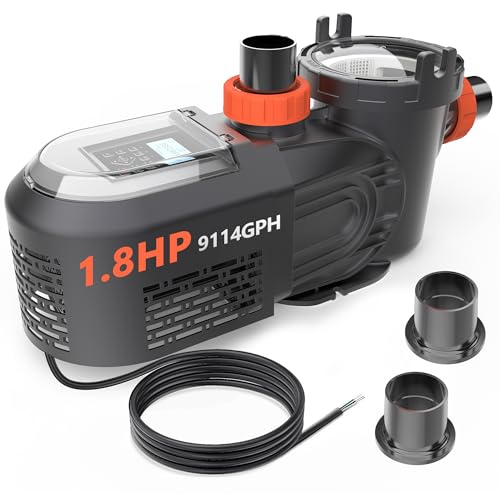
Variable-speed pumps are the quieter, more efficient alternative to single-speed models because they let you dial motor RPM (revolutions per minute) to match the task, instead of always running flat-out. VARMINPOOL’s 1.8 HP entry uses a permanent magnet motor, a more efficient motor design than standard induction types, paired with inverter technology to ramp speed from roughly 1,200 to 4,000 RPM. Peak flow is 9,114 GPH, more than enough for typical residential pools, and the saltwater compatibility is a real plus for chlorinator-equipped systems.
Compared to the Aquastrong 1.5 HP dual-speed covered earlier, this one trades two preset speeds for full stepless control, so the savings on electricity tend to be more dramatic. For most saltwater pool owners, that’s a fair trade.
The Upside
- Variable-speed control with permanent magnet motor for serious energy savings
- Saltwater compatibility avoids galvanic wear common to less specialized pumps
- 9,114 GPH ceiling handles most mid-to-large residential pools comfortably
Points To Note
- Programming the speed schedule takes a one-time learning curve that simpler pumps skip
- Heavier inverter electronics raise the unit’s weight over a comparable single-speed pump
Key Specs
Best Suited To
Salt-chlorinated inground pool owners who want serious energy savings and a longer dialed-in daily schedule.
Where Another Pick Suits Better
Owners who want a similar speed range with a programmable timer and a 2.5 HP ceiling from the VARMINPOOL 2.5 HP Variable-Speed Pool Pump.
This is the largest variable-speed entry in the roundup, with a 2.5 HP permanent magnet motor pushing up to 10,567 GPH and a programmable timer for hands-off daily operation. The included rain cover is a thoughtful touch, since uncovered electronics and storm runoff don’t mix well. Step-less speed control across 1,200 to 4,000 RPM gives the same dialed efficiency as the smaller 1.8 HP model covered earlier, just with more headroom for solar heaters, water features, or large pools.
For most backyard pools, the honest read is that 2.5 HP is plenty of headroom, and the programmable timer earns its keep if you’d rather not babysit the equipment pad.
Notable Upsides
- 10,567 GPH ceiling for large pools, heaters, and aggressive water features
- Programmable timer automates the daily schedule without manual intervention
- Step-less speed across a wide RPM range for precise, energy-aware control
- Large filter basket cuts down on how often you’ll need to clear debris
Some Limits To Know
- At 2.5 HP, plumbing that isn’t sized to the higher flow can throttle performance
- Variable-speed programming takes longer to set up than a single-speed pump
- The unit is heavier than the smaller VARMINPOOL 1.8 HP, so mount the pad accordingly
Who Will Love This
Pool owners running solar heating, multi-feature water walls, or large-volume inground pools who want automated efficiency.
Reach For A Different Pick When
Your pool is more straightforward, since the Aquastrong Riptide 2 HP Dual-Speed pool pump covers the same workload with simpler controls.
The Hayward TriStar VS is the legacy brand entry in this roundup, and the one that most service professionals reach for first when replacing an aging full-rate pump. Sized to drop into systems originally running 1.5 full-rate or 2.0 max-rate HP pumps, the permanent-magnet, totally enclosed fan-cooled (TEFC) motor is the kind of hardware you expect from a brand that has been building pool equipment for decades. It’s a variable-speed unit, so it qualifies for many local utility rebate programs that single-speed pumps don’t.
For whole-system upgrades where plumbing, controls, and pad layout are already designed around premium equipment, this is the dependable choice. Hayward’s aftermarket support and parts availability tend to be the deciding factor over newer entrants.
What Helps Most
- Hayward’s reputation for build quality and accessible replacement parts
- TEFC permanent magnet motor designed for long daily run cycles
- Variable-speed operation that may qualify for local energy rebates
Things To Weigh
- Higher upfront cost than most Aquastrong and VARMINPOOL alternatives in the roundup
- Professional installation is often the easiest path, adding to total outlay
Feature Rundown
Perfect Match For
Homeowners committing to a whole-system professional upgrade who value Hayward’s service network and parts availability.
A Better Fit Elsewhere
Budget-focused shoppers who only need reliable circulation from the VARMINPOOL 1.8 HP Variable-Speed Inverter Pool Pump.
The 2 HP dual-speed sits between the 1.5 HP covered earlier and the 3 HP from the same line, and that middle position is its real strength. With 8,586 GPH on high and 4,427 GPH on low, it carries most residential inground pools comfortably without being oversized for a 15,000-gallon setup. The pure copper motor handles long run cycles well, and the dual-speed design offers noticeable runtime savings over single-speed alternatives.
For homeowners who like the idea of a higher-flow unit but don’t need the 10,000+ GPH headroom of the 3 HP, this is the more proportionate match.
The Case For It
- 8,586 GPH ceiling fits mid-to-large residential pools without oversizing
- Dual-speed runtime gives flexibility for quiet daily circulation
- Pure copper motor for cool operation across long cycles
Points To Keep In Mind
- 220V wiring required, so plan for a dedicated circuit if your pad isn’t set up for it
- Filter basket access means occasional debris clearing, especially during leaf-heavy seasons
Who Should Grab It
Homeowners with mid-to-large pools who want more flow than the 1.5 HP dual-speed without stepping up to the 3 HP.
Not Your Match When
You want fully stepless speed control, since the Aquastrong Riptide 2 HP Single-Speed pool pump is the simpler, lower-cost alternative if speed flexibility isn’t a priority.
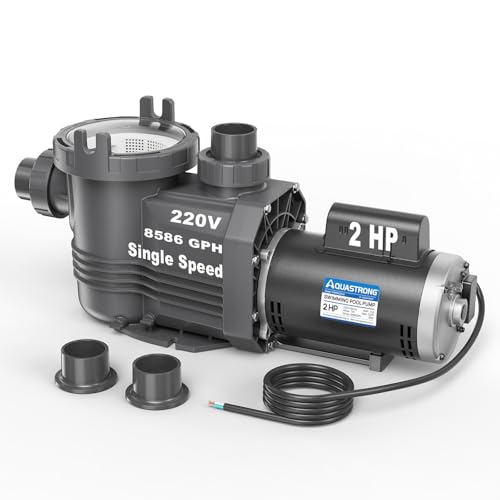
The single-speed 2 HP gives up the dual-mode flexibility of its sibling covered above in exchange for a simpler, lower-cost build. It still pushes 8,586 GPH through a pure copper motor, so the core performance numbers hold, and the self-priming housing with filter basket works the same way. For homeowners who want set-and-forget operation and aren’t chasing the efficiency gains of variable-speed tech, this is the straightforward choice.
The honest read is that single-speed pumps run at full tilt whenever they’re on, so the electricity cost difference versus the dual-speed or variable-speed models adds up over a typical swim season. Still, the lower purchase price can offset that for a few years of ownership.
Reasons It Performs
- Strong 8,586 GPH flow at a lower cost than variable-speed alternatives
- Pure copper motor that handles continuous run cycles reliably
- Simpler controls mean almost no setup or programming to learn
Possible Compromises
- Single-speed operation runs at full power all day, raising electricity use noticeably
- Quieter low-speed mode is not available on this single-speed version
Built With In Mind
Set-and-forget homeowners who want strong flow without paying for the dual-speed or variable-speed hardware.
Where A Sibling Pick Shines
Energy-focused owners who want two-speed control should reach for the Aquastrong Riptide 2 HP Dual-Speed pool pump instead.
For first-time pool owners and small above-ground or modest inground setups, the 1.5 HP single-speed Riptide is the most accessible entry in the roundup. It pushes 6,604 GPH through a pure copper motor with the same self-priming filter basket housing as the larger models, just at a friendlier footprint and price. Operation is genuinely plug-and-play: power on, prime, and let it run.
If your pool is under 12,000 gallons and you don’t need the runtime savings of dual-speed or variable-speed tech, this one is hard to overcomplicate.
The Value In It
- Modest flow rate sized for small inground and most above-ground pools
- Pure copper motor and self-priming housing shared with higher-tier Riptide models
- Simplest controls in the roundup, so setup is essentially instant
Where It Is Less Suited
- Single-speed operation costs more in electricity than dual-speed or variable-speed alternatives
- 6,604 GPH ceiling is too low for large pools or those with attached spas
Made For
First-time pool owners with smaller pools who want a simple, no-programming-required upgrade.
Skip It When
Your pool is mid-size and you’d benefit from the two-speed flexibility of the Aquastrong Riptide 1.5 HP Dual-Speed pool pump.
Picking the Right Pump for Your Pool Setup
Match Horsepower to Pool Volume, Not Just Branding
A 1.5 HP pump is enough for many residential pools under 18,000 gallons, and pushing into a 3 HP unit “just in case” usually means more electricity spent on flow you don’t need. The variable-speed and inverter picks reviewed above let you match flow to the task, which is where the real long-term savings come from.
Know Your Electrical Setup Before You Order
Every pump in this roundup runs on 220V, and most equipment pads aren’t pre-wired for that. If your current pump is a 110V model, plan an electrician visit alongside the new pump purchase. Skipping that step is a common reason equipment sits uninstalled for weeks.
Copper Motors vs Aluminum Windings
A pure copper motor runs cooler and typically outlasts an aluminum-wound equivalent under continuous duty. That’s not a guarantee, but it tends to show up in long-term reliability across the Riptide line reviewed above.
Variable-Speed Pays Back Over Time
The 1.8 HP and 2.5 HP VARMINPOOL entries, plus the Hayward TriStar VS, all qualify for potential utility rebates in many regions. Between rebates and lower daily run costs, variable-speed often pays back the higher upfront cost within a few swim seasons. Check your local program before committing to a single-speed build.
Practical Wisdom Before You Commit
Wrong Turns To Avoid
First-time pool owners sometimes pick the highest-horsepower pump they can find, assuming more power means cleaner water. Flow that exceeds the filter and plumbing capacity actually reduces filtration efficiency. Match horsepower to pool volume and turnover rate, not to a marketing number on the box.
Where The Extra Money Goes
Variable-speed and inverter models cost more up front, and that premium pays for permanent magnet motors, electronic speed controls, and quieter operation. For pools running 8+ hours a day, the efficiency gain typically shows up on the bill within a couple of seasons.
Frequently Asked Questions
How Do I Know What Horsepower I Need?
Match the pump’s flow rate to your pool’s volume and the turnover target (the time to circulate all the water through the filter once). Most residential pools turn over in 8 to 10 hours; the flow ratings in each review help you size the unit to that target.
Can I Install a 220V Pool Pump Myself?
Homeowners with electrical experience sometimes handle the wiring themselves, but most pool pros recommend a licensed electrician for any new 220V circuit. The pump side of installation is usually straightforward once the wiring is in place.
How Often Should I Clean the Pump Basket?
Weekly during heavy leaf season, and roughly every two to three weeks otherwise. Letting debris build up in the basket restricts flow and forces the motor to work harder, which shortens its service life.
Are Variable-Speed Pumps Worth the Higher Cost?
For pools running long daily cycles, the electricity savings and potential utility rebates usually pay back the price difference over a few years. The added benefit of much quieter operation is what tips the decision for many homeowners.
Can I Use a Replacement Lid on a Different Brand Pump?
Only if the part number and physical dimensions match exactly. The Adozsb replacement covered at the top of this roundup fits a specific list of Pureline and Splapool model numbers, and forcing a mismatched lid leads to air leaks and poor priming.
Wrap Up
The right pump comes down to your pool’s size, your electrical setup, and how much you value quiet operation over upfront cost. Smaller pools do well with a single or dual-speed Riptide, mid-size setups benefit from variable-speed VARMINPOOL models, and whole-system professional upgrades land on the Hayward TriStar VS. If you only need to revive an aging Pureline system, the replacement lid handles that on its own. Pick the profile that matches your yard, and the rest of the season gets a lot easier.