

A weak blast of lukewarm air on a 95-degree day has a way of getting your attention fast. Most people picture a costly shop visit the moment the vents stop cooperating, but a basic recharge can put a struggling home window unit, refrigerator, or older vehicle system back in working order. The trick is matching the kit to the refrigerant your equipment actually runs on, then using the right hose and gauge setup so the charge lands where it belongs.
This list rounds up six air conditioner recharge kits that cover the common scenarios: R134a systems that need either replacement gas or just a fresh can tap, a piercing-valve setup aimed at refrigerator lines, and an R1234YF option for newer vehicles. The picks split between full gas kits and standalone hose tools, so you can fill in the missing piece of an existing setup rather than buying everything twice.
The Shortlist At A Glance
ZeroR AC Refrigerant R134a Replacement (6 Cans)
gohantee R134a Recharge Hose with Gauge (51″)

Wadoy Refrigerator Freon Recharge Kit with BPV31

ZeroR AC Refrigerant R134a Replacement (3 Cans)

ZeroR Permafrost for R1234YF Systems (3 Cans + Hose)
ZeroR AC Recharge Kit R134a Replacement with 24″ Hose (3 Cans)
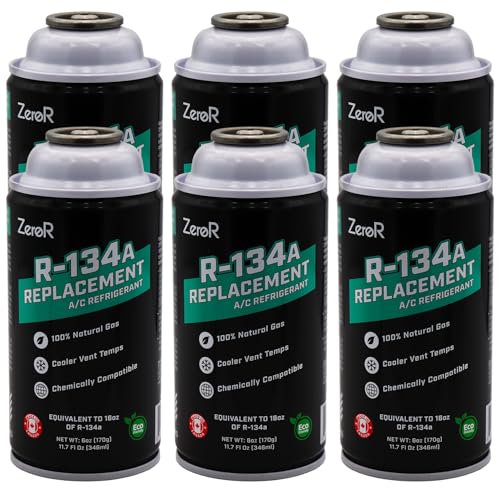
ZeroR’s six-can pack is built for folks who maintain more than one R134a system, or who just like having spare gas on a shelf for the next slow leak. The refrigerant (the cooling agent that circulates through your system to absorb heat) is a natural hydrocarbon blend rather than a traditional HFC, which the brand positions as a gentler pick for the environment while still fitting existing R134a threads and fittings.
Each 6oz can claims to deliver cooling performance comparable to roughly 16oz of standard R134a, so you use less product per charge. The cans thread onto standard R134a can taps, and the included safety rating (class 2.1, in the same family as R1234YF) tells you it behaves like other modern flammable refrigerants under normal handling.
The Upside
- Six cans mean you can top off a vehicle, a window unit, and a small shop cooler without reordering
- Standard R134a threads drop onto your existing can tap and gauge setup
- Smaller can weight with claimed equivalent cooling to a larger R134a charge
- Hydrocarbon blend is positioned as a lower-impact alternative to traditional HFC gas
Things To Consider
- Not legal for use in passenger vehicle AC systems in some regions, so check local rules before charging a car
- Flammable like other modern refrigerants, so storage away from heat sources matters
Who It Suits Best
Homeowners and shop users with multiple R134a appliances who want one multi-can order to keep on hand.
Where Another Pick Suits Better
Drivers with R1234YF vehicle systems get a more purpose-built match in the ZeroR Permafrost kit covered below.
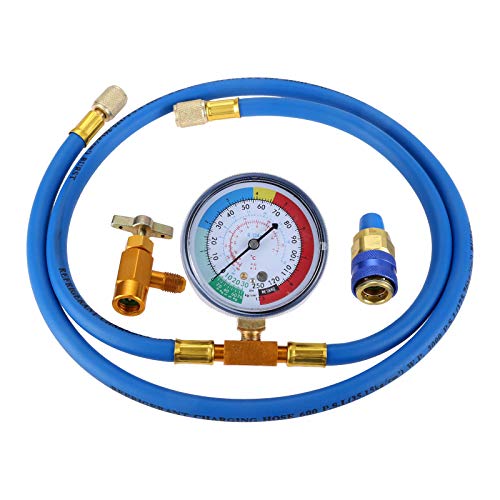
Where the ZeroR pack delivers the gas, the gohantee kit delivers the tool. This is a 51-inch charging hose with a built-in gauge and a self-sealing R134a can tap, plus a low-side quick coupler (the push-on fitting that locks onto your service port without losing refrigerant). It’s the piece most DIYers reach for when their car AC starts blowing warm and they already have a can of gas on the shelf.
The hose length is a real benefit in tighter engine bays, since shorter 12-inch lines often fight you when the low-side port hides behind intake plumbing. The fittings cover R134a, R12, and R22 ports, so it crosses over between automotive and home AC tasks.
Points In Its Favor
- 51-inch hose reaches low-side ports that shorter lines cannot
- Self-sealing can tap means no refrigerant escapes when you swap cans
- Built-in gauge gives live pressure readings during the charge
Worth Noting
- This is a hose and tap only, so you still need to supply your own refrigerant cans
- Self-sealing taps only work with compatible R134a cans, not piercing-style containers
Key Specs
Made For
DIYers who already own refrigerant cans and need a proper hose and gauge to top off their car.
Skip It When
You want a complete kit with gas included, in which case the ZeroR three-can kit with hose is a more direct fit.
Refrigerators and small chest freezers don’t have the same convenient service port you’ll find on a car, which is exactly where the Wadoy kit earns its place. It pairs a BPV31 piercing valve (a clamp-on fitting that punctures the thin copper refrigerant line so you can add gas) with a 19-inch charging hose rated for R134a-to-R12/R22 conversions.
The metal and reinforced rubber construction holds up under the higher pressures involved in sealed-line work, and the leak-resistant design matters when a slow drip is the whole reason your fridge stopped cooling in the first place. For anyone diagnosing a refrigerator that runs constantly without getting cold, this kit opens up the kind of repair that normally means a service call.
Strong Points
- BPV31 piercing valve lets you access sealed refrigerant lines without soldering
- Reinforced hose and metal fittings handle high-pressure charging
- Useful across R134a, R12, and R22 system types
Trade Offs
- Piercing a line creates a small permanent hole, so the repair is one-way and not for high-end sealed systems
- You’ll still need to source compatible refrigerant cans separately
- Refrigerator repairs can involve other faults besides low refrigerant, so results vary case by case
Right Fit For
Homeowners troubleshooting an aging fridge or freezer before deciding whether to call a technician or replace the unit.
Consider Something Else When
You’re working on a vehicle system, where the gohantee hose and can tap setup is the closer match.
The three-can version of the ZeroR R134a replacement follows the same hydrocarbon recipe as the six-pack above, just in a smaller dose. For first-timers who want to test the waters on one appliance or vehicle before committing to a larger refill, three cans tends to cover a single top-off with a little in reserve.
The threads match standard R134a can taps, so the same gohantee hose from earlier in this list pairs cleanly with these cans. You get the same claimed efficiency story, where each 6oz can performs like a 16oz can of traditional R134a, which helps explain why three cans is a popular starting quantity.
Everyday Wins
- Right-sized starter pack for a single recharge job
- Drops onto any standard R134a can tap you may already own
- Smaller can footprint means easier storage in a garage or utility shelf
Points To Note
- Three cans may fall short for larger AC systems or for tackling more than one appliance
- Like the six-pack, flammability and local-use rules apply
Feature Snapshot
Best Suited To
First-time users who only need a single can or two and want a low-commitment entry point.
Look Elsewhere When
You service multiple AC units over the year, where the six-can ZeroR pack stretches further per dollar.
Most vehicles built after about 2018 use R1234YF refrigerant instead of R134a, and the fittings are different enough that a standard R134a can tap will not thread on. The ZeroR Permafrost kit solves that gap with three 4oz cans of a performance booster plus a 24-inch HD can tap and gauge designed specifically for R1234YF service ports.
It is worth noting that this product is labeled a performance booster rather than a full refrigerant replacement, combining a moisture-removal agent with a friction-reducing component. The longer 24-inch hose reaches low-side ports that shorter lines struggle with, and the included gauge helps you avoid overfilling.
Positive Points
- Threads and gauge are matched to R1234YF service ports, where generic R134a tools will not fit
- 24-inch hose reaches recessed low-side fittings on modern engine bays
- Combines moisture removal and friction reduction in one charge
Potential Drawbacks
- This is a booster, not a full refrigerant replacement, so heavily undercharged systems still need proper servicing
- Flammable product, so safe storage away from heat sources is a real ownership consideration
Who Should Grab It
Owners of newer R1234YF-equipped vehicles who want a maintenance top-off between full service visits.
A Better Fit Elsewhere
Owners of older R134a vehicles should pick the gohantee hose or the ZeroR R134a replacement cans instead.
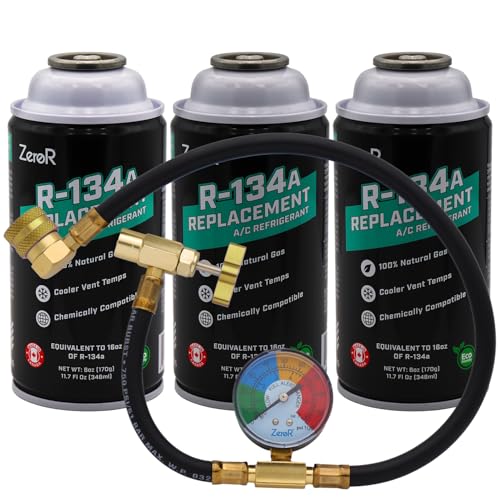
This bundle ties the loose ends together. You get three 6oz cans of ZeroR’s R134a replacement gas alongside a 24-inch charging hose built for self-sealing valve (SSV) cans, which are different from piercing-style cans because the valve closes itself when you disconnect, so leftover gas stays usable for next time.
The trade-off shows up if you already own a hose that was designed for piercing cans, since SSV cans need a compatible tap to release refrigerant at all. For shop owners and serious home tinkerers, the matched pair removes that guesswork, and the 6oz can size keeps partial cans from going to waste between jobs.
Useful Strengths
- Gas and hose are sold as a matched pair, so no compatibility guesswork
- SSV cans let you store partially used gas for later top-offs
- Compatible with R134a systems, including many home window units and shop equipment
Honest Caveats
- SSV cans require the included style of tool, so older piercing-type hose kits are not a substitute
- Flammable contents mean safe handling and storage away from heat sources
- Not approved for use in some vehicle AC systems depending on local rules
Quick Facts
Whose Shelf It Belongs On
Workshop owners and home tinkerers who recharge R134a gear often enough to want hose and gas in one purchase.
Reach For A Different Pick When
You service newer R1234YF vehicles, where the ZeroR Permafrost kit covers that specific port style.
## What To Match Before You Recharge Knowing which refrigerant your system actually uses is the single most important step. R134a has been the automotive standard for decades, but R1234YF has taken over in newer vehicles, and the fittings are not interchangeable. For refrigerators, small chest freezers, and some window units, R134a is still common, but the system may not have an external service port at all, which is when a piercing-valve kit becomes necessary. Hose length and tap style matter more than people expect. A 12-inch hose can be a real struggle on a transverse-mounted engine, where the low-side port sits buried behind the intake manifold. A 24- or 51-inch hose gives you room to read the gauge and the can at the same time. Self-sealing can taps keep refrigerant in the can when you swap or stop mid-charge, while piercing-style taps punch a hole that lets air and moisture back in, which shortens can life. Flammability is a real ownership factor with modern hydrocarbon and R1234YF refrigerants. Storage away from heat sources, garages, and direct sunlight is a sensible habit, and the same caution applies during use. For occasional top-offs in a home garage, that is manageable, but anyone running a busy shop should think about ventilation and a dedicated storage cabinet. ## Key Considerations Across These Picks ### Mistakes Worth Dodging The most common slip-up is grabbing an R134a can tap for an R1234YF vehicle, or vice versa. The threads look similar at a glance, but they do not match, and forcing a fitting can damage the can valve or the service port. Confirming your refrigerant type before you order saves the headache of a return. Another trap is treating a recharge as a cure-all. Refrigerant leaks mean there is a hole somewhere, and adding gas without finding it just resets the clock. If a system loses pressure within a few weeks of charging, the underlying leak deserves attention before any more gas goes in. ### What The Higher Tier Buys Stepping up to a longer hose, a self-sealing can tap, or a matched gas-and-tool bundle like the ZeroR SSV kit mostly buys convenience and less waste. A short hose with a piercing tap works fine for a one-time job, but the upgrade pays off the moment you do a second recharge, since leftover gas stays sealed and you stop fighting the fitting in tight spots. For R1234YF vehicles, the dedicated booster kit is less about quality and more about the right tool for the port style, which is its own kind of upgrade. ## Frequently Asked Questions ### What is the difference between R134a and R1234YF? R134a is the older hydrofluorocarbon refrigerant used in most vehicles and appliances built before roughly 2018. R1234YF is the newer replacement with a lower global warming impact, and it uses different service port fittings, so R134a tools generally do not fit R1234YF systems. ### Can I recharge my home AC window unit myself? Many small window units do not have external service ports, which makes a true recharge difficult without a technician. If the unit is the type that uses a Schrader valve and R134a, a basic can tap and hose setup can work, but a slow cooling problem is often a sign of a bigger issue. ### Is hydrocarbon refrigerant safe to use at home? Hydrocarbon blends like ZeroR are flammable and should be stored away from heat sources, sparks, and direct sunlight. Used in a sealed system designed for refrigerants, they behave like other modern refrigerants under normal conditions, but good ventilation during charging is always sensible. ### Do I need a gauge to recharge AC? A gauge is strongly recommended. Without one, you are charging blind and risking overfilling the system, which can reduce cooling performance and stress the compressor. The gohantee hose and the kits with built-in gauges both solve that problem. ### How do I know if my system is low on refrigerant? Common signs include air that feels warmer than usual, a compressor that runs constantly without reaching set temperature, and visible frost on the refrigerant line at the indoor unit. None of these are proof of low refrigerant on their own, but together they make a recharge worth investigating.