

Servo motors look similar on paper, then behave very differently once they hit your workbench. The right pick powers a smooth CNC spindle, a steady robot arm, or a reliable RC build without fuss. This roundup focuses on AC servo motors that pair serious torque with usable control electronics, so you spend less time debugging and more time building. Hobbyists, small shop owners, and automation tinkerers will all find something tuned to their setup.
The Choices Worth Comparing
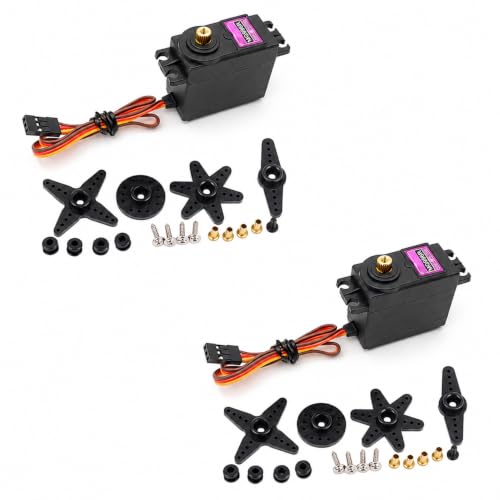
Treedix MG996R Metal Gear Servo Motor (360°)

RATTMMOTOR 1000W 220V Servo Motor with Brake
RATTMMOTOR YPMC-1000W 110V Servo Motor with Brake

CNCTOPBAOS 1.8KW AC Servo Motor Driver Kit

CNCTOPBAOS 1HP 750W Brushless Servo Motor Kit

RATTMMOTOR YPMC-750W 110V Servo Motor with Brake

CNCTOPBAOS 550W Brushless AC Servo Motor Kit
Taking A Closer Look At The Options
The Treedix MG996R shows up in a two-pack, which feels generous for anyone building a robot arm or upgrading a few RC vehicles at once. The metal gear train gives it noticeably more bite than plastic-gear servos in the same size class, and the upgraded 360° control angle makes it behave almost like a continuous-rotation drive when your code calls for variable speed.
Compared to the heavier industrial picks later in this list, this one runs on standard hobby receiver connections like Futaba, Hitec, and Sanwa. You won’t be driving a CNC spindle with it, but for smart cars, robotic claws, and mechanical arm fittings, it’s a reliable workhorse. The shock-tolerant design helps it survive the occasional rough landing or stalled load.
What Stands Out
- 360° continuous rotation behaves like a stepless speed motor
- Metal gears handle repeated stall loads better than nylon
- Two-pack saves money on multi-axis projects
- Broad receiver compatibility means no rewiring
Things To Consider
- Not a true AC servo, so it won’t suit industrial automation
- Heat buildup can shorten run times under constant load
- Wire length is short, so plan extensions for larger builds
At A Glance
Right Fit For
RC hobbyists and robotics beginners building smart cars, robotic arms, or mechanical fittings on a hobby receiver.
Skip It When
You’re driving a CNC spindle or industrial line, in which case the RATTMMOTOR 1000W 220V Servo Motor brings the proper AC torque.
Step up to genuine industrial territory and the RATTMMOTOR 1000W 220V arrives ready to anchor a real work cell. The integrated brake is the headline feature, locking the shaft the instant power cuts so a vertical axis doesn’t drop its load. Pair it with the included servo driver and you have a matched system rated for serious cycling duty.
Unlike the Treedix hobby servo above, this motor demands a 220V feed and a proper enclosure. The IP65 rating means dust and water spray won’t faze it on a shop floor, and the 10,000-pulse encoder resolution gives clean positioning for packaging or assembly lines. For anyone retrofitting a machine tool, the triple-overload capacity offers a comfortable safety margin during peak torque events.
Well-Handled Touches
- Integrated holding brake adds a layer of safety on vertical axes
- 10,000-pulse encoder keeps positioning smooth and repeatable
- IP65 sealing shrugs off coolant splash and shop dust
- Triple overload tolerance helps during sudden load spikes
Points To Note
- Requires 220V supply, not a drop-in for standard 110V shops
- Larger frame demands proper mounting hardware and clearance
Best Suited To
Industrial automation builders running 220V machinery who need a braking servo for vertical or holding-load applications.
Consider Something Else When
Your shop only has 110V outlets, in which case the RATTMMOTOR YPMC-1000W 110V Servo Motor drops right in without rewiring.
Most North American shops run 110V, and that’s exactly where this RATTMMOTOR YPMC-1000W earns its place. It carries the same braking safety and 10,000-pulse encoder as its 220V sibling, but in a package you can plug into a standard outlet. The 5-pole-pair design also keeps low-speed torque steady, which matters when you’re feeding a heavy spindle or driving a conveyor at crawl speed.
Versus the 220V version above, the trade-off shows up in peak RPM. You give up a little top speed for the convenience of a 110V hookup, but most home-shop CNC and automation projects never need 6000 RPM anyway. The matched driver and pre-wired brake make installation less of a wiring puzzle than sourcing components separately.
Benefits That Matter
- 110V input means no transformer or dedicated line needed
- Holding brake prevents load drop on power loss
- 10,000-pulse encoder gives clean positioning feedback
- 5-pole-pair design holds torque at low speeds
- IP65 rating survives typical shop dust and coolant mist
Honest Caveats
- Peak RPM is lower than the 220V sibling
- Wiring the brake and driver takes careful attention to the manual
- Cooling vents need clearance, so sealed enclosures aren’t ideal
Key Specs
Made For
North American hobby machinists and small-shop owners who need 1000W of braking torque without reworking their electrical panel.
A Better Fit Elsewhere
You already run 220V in your shop, where the RATTMMOTOR 1000W 220V Servo Motor delivers higher peak RPM for the same brake-and-driver convenience.
The CNCTOPBAOS 1.8KW kit sits at the top of this list for one reason: a 17-bit single-coil absolute magnetic encoder. That resolution translates into positioning accuracy down to roughly one millionth of a turn, which is the kind of precision CNC routers and semiconductor handlers quietly depend on. The 19mm shaft and 10.66-lb frame signal a serious piece of iron meant for industrial manipulators and engraving rigs.
Compared to the 1000W RATTMMOTOR above, this motor pushes 1.8KW and a peak torque of 16.2Nm, plenty for cutting hardwood or driving a 4th axis. The driver accepts single or three-phase input, and the freely defined I/O ports let you wire it into most control architectures without custom adapters. It’s overkill for a basic router, but for tight-tolerance work it’s a comfortable fit.
Reasons It Performs
- 17-bit encoder enables micron-level positioning accuracy
- 1.8KW output handles demanding spindle and axis work
- Flexible I/O ports adapt to most CNC control systems
- Insulation class F winding tolerates long duty cycles
Trade Offs
- Premium positioning comes with a heavier price tag
- Larger frame demands more enclosure space
- Setup rewards users comfortable with tuning servo parameters
Perfect Match For
Pro CNC machinists, lab technicians, and automation engineers building equipment that demands micron-level repeatability.
Another Choice May Suit
Your build only needs 750W for a mid-size router, in which case the CNCTOPBAOS 1HP 750W Brushless Servo Motor Kit offers a friendlier learning curve.
Mid-size CNC routers and benchtop mills rarely need 1.8KW, and the CNCTOPBAOS 1HP 750W lands in a sweet spot. The 110V brushless permanent magnet design runs on the same outlet as your bench grinder, and the 200 to 6500 RPM stepless range covers everything from slow plunge cuts to fast traverse moves. The 8-pole-pair configuration keeps low-RPM torque steady, which is where many cheaper motors fall flat.
Versus the 1.8KW kit above, this one trades raw power for accessibility. Class F insulation helps it survive 72-hour continuous runs, and CW/CCW control signals integrate cleanly with common step-direction controllers. The brushless design also means less routine maintenance than brushed alternatives.
Strong Points
- Stepless 200-6500 RPM range covers most cutting speeds
- 110V input drops into standard shop circuits
- 8-pole-pair design holds torque at low RPM
- Brushless construction reduces long-term wear
Room For Improvement
- Less torque headroom than the 1.8KW sibling
- Encoder resolution is lower than premium 17-bit kits
- Driver tuning still requires some patience on first install
Feature Snapshot
Who Will Love This
Mid-size CNC router owners and advanced hobbyists who want brushless reliability without paying for industrial-tier power.
Look Elsewhere When
You need a holding brake for vertical axis safety, where the RATTMMOTOR YPMC-750W 110V Servo Motor adds that critical feature.
Sometimes a 750W servo just needs to keep its load from sliding when the power dies. The RATTMMOTOR YPMC-750W 110V with integrated brake answers that exact need, and the included driver keeps wiring straightforward. It’s the smaller sibling of the 1000W 110V motor reviewed earlier, with a more compact 2.4Nm rated torque for lighter conveyors, Z axes, and indexing tables.
The trade-off versus the CNCTOPBAOS 750W brushless kit reviewed just above is the holding brake versus higher top speed. Choose this one when safety on power loss matters more than 7000 RPM ceiling runs, and the brushless CNCTOPBAOS when continuous high-RPM work defines your day.
Where It Delivers
- Integrated brake holds position during emergency stops
- 110V compatibility suits residential-shop wiring
- 10,000-pulse encoder provides clean position feedback
- Compact 2.4Nm rating fits tight enclosure spaces
Small Caveats
- Lower peak torque than the 1000W sibling
- Brake wear means occasional adjustment over years of cycling
Whose Shelf It Belongs On
Builders of light automation, vertical Z axes, and small conveyor systems where power-loss safety matters.
Reach For A Different Pick When
You want higher RPM for spindle work, where the CNCTOPBAOS 1HP 750W Brushless Servo Motor Kit stretches up to 6500 RPM without a brake.
First time wiring a real AC servo? The CNCTOPBAOS 550W brushless kit keeps things manageable. At 1.85Nm rated torque, it won’t bully you during tuning, yet the 200 to 7000 RPM range still covers small CNC routers, pen plotters, and educational robotics platforms. The 110V input means you can prototype on a kitchen-counter outlet before committing to a shop buildout.
Compared to the 750W kit a few rows up, this one asks less of your power supply and produces less heat under load. The 8-pole-pair brushless architecture still delivers that signature low-RPM torque, so your first cuts in soft wood won’t stall. For most learning projects, it’s the gentlest on-ramp in this list.
A Few Highlights
- 110V input works on a standard household outlet
- Stepless 200-7000 RPM covers a wide project range
- Brushless design means less routine maintenance
- Compact enough to mount in a small enclosure
- Class F insulation supports extended learning sessions
A Few Limitations
- Limited torque headroom for harder materials
- No holding brake, so vertical loads need external locking
Who Should Grab It
First-time servo builders, students, and makers exploring CNC or robotics on a residential electrical setup.
Where A Sibling Pick Shines
You’re ready for a holding brake and more torque, where the RATTMMOTOR YPMC-750W 110V Servo Motor delivers both without leaving 110V territory.
What To Weigh Before Choosing Ac Servo Motors
Power, Voltage, and Your Shop’s Wiring
The first decision is what your electrical panel can actually deliver. A 110V motor drops into standard North American outlets, while 220V units demand a dedicated line or a step-up transformer. Match the motor’s rated power (in watts or kilowatts) to the load, not the maximum your breaker can supply. For a 1.8KW motor, expect to need a 20-amp circuit at 110V or a smaller draw at 220V.
Torque, Speed, and Encoder Resolution
Rated torque tells you how much the motor can push continuously, while peak torque covers short bursts. Encoder resolution, measured in pulses per revolution or bits, defines positioning precision. A 17-bit encoder, like the one in the CNCTOPBAOS 1.8KW kit, gives roughly 131,072 counts per turn, which matters for tight-tolerance CNC work. A 10,000-pulse encoder is plenty for general automation.
Brakes, Frames, and Environmental Sealing
A holding brake locks the shaft when power cuts, critical for vertical axes where loads would otherwise drop. IP65 sealing protects against dust and water spray, a common shop floor reality. Frame size and shaft diameter (often 19mm on industrial units) also dictate mounting hardware and coupling choices. Plan your enclosure dimensions before ordering.
Driver Match and Control Compatibility
Servo motors need matched drivers, and many kits include one for plug-and-play setup. Check that the driver accepts your control signal (CW/CCW, step/direction, or analog) and that the I/O ports match your controller’s outputs. A freely defined I/O port layout, like the CNCTOPBAOS kits offer, adapts to more architectures without rewiring.
Key Considerations Across These Picks
Pitfalls Shoppers Hit
Many first-timers grab a 220V motor without checking their shop wiring, then stall a project waiting for an electrician. Others chase the highest wattage and end up with a 1.8KW motor buzzing on a small router where 550W would have been quieter and more controllable. Encoder resolution gets ignored until the first precision cut disappoints, so map your real tolerance needs before picking. Finally, confirm brake presence for any vertical axis, because retrofitting a brake later usually means replacing the whole motor.
Where The Extra Money Goes
Stepping from a 550W to a 1.8KW kit buys more than raw wattage. You get higher pulse-count encoders, beefier frames, and drivers with richer tuning options, all of which translate into cleaner cuts and longer service life. Premium kits also tend to carry higher IP ratings and insulation classes, which protect against the dust, coolant, and heat that punish budget motors in busy shops. The upgrade pays off most when your project runs long duty cycles or demands repeatability measured in microns.
Frequently Asked Questions
What is an AC servo motor used for?
An AC servo motor drives machines that need precise control of position, speed, and torque, such as CNC routers, robotic arms, and automated packaging lines. The closed-loop feedback system constantly corrects for errors, which keeps performance tight under varying loads.
How does an AC servo motor differ from a DC servo?
AC servo motors run on alternating current, generally use brushless designs for less maintenance, and handle higher power levels common in industrial settings. DC servos run on direct current and suit smaller hobby and robotics projects where simplicity matters more than continuous heavy-duty cycling.
What voltage should I choose for my shop?
Choose 110V if your shop runs on standard North American residential circuits, and 220V if you already have a dedicated industrial line. Higher voltage allows more power with less current draw, which keeps wiring thinner and motors cooler during long duty cycles.
Do I need a holding brake on my servo?
You need a holding brake on any vertical axis or application where the load must stay put during a power loss. Horizontal axes without suspended loads can usually skip the brake, which simplifies wiring and lowers cost.
What does encoder resolution mean in practical terms?
Encoder resolution defines how finely the motor can measure shaft position. A 10,000-pulse encoder gives smoother motion for most automation tasks, while a 17-bit absolute encoder, like the CNCTOPBAOS 1.8KW kit, delivers micron-level precision for demanding CNC and semiconductor work.