

A dead fan motor has a way of choosing the worst possible moment. You hear the buzz, the click, or just dead silence on a 95-degree afternoon, and suddenly the repair budget matters. The good news: replacement motors for everything from a tired bathroom exhaust to a hard-working condenser unit have become genuinely accessible, and the right match usually comes down to voltage, RPM, horsepower, and shaft geometry.
This roundup covers seven AC electric fan motors aimed at the most common residential and RV repair scenarios. Each pick here was selected for a distinct job, so the shortlist reads more like a toolkit than a leaderboard. Use the table below to find the right fit, then dive into the reviews for the details that matter for your specific repair.
A Fast Comparison Of The Options

PANDEELS Universal Bathroom Fan Motor Replacement Kit

VEVOR 1/4 HP Condenser Fan Motor 1100RPM

VEVOR 1/5 HP Condenser Fan Motor 1075RPM

VEVOR 1/6 HP Condenser Fan Motor 1075RPM

VEVOR 1/10 HP Condenser Fan Motor 1100RPM

Howaoo SP-B9HS16 Condenser Fan Motor 9W
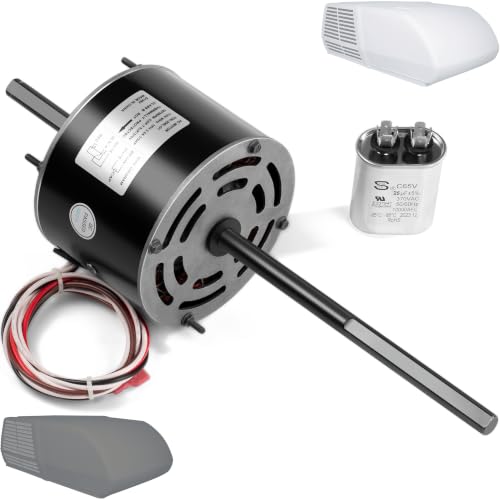
HHQ RV AC Motor 1/3 HP with Capacitor
The Strengths Of Each Pick
Bathroom exhaust fans are one of the most forgiving repairs in the house, and the PANDEELS Universal kit leans into that. It’s built around a 120V, 60Hz motor pulling 0.29A at roughly 3000 RPM, which matches the small-form fans most homes have in a hall bath or powder room. The kit arrives with a blower wheel attached, so you spend less time fiddling with set screws on a stepladder and more time getting the cover back on.
For a homeowner staring down a noisy or stuck bathroom fan, this is the kind of swap that can be done in an afternoon. Compared with the larger condenser units that come later on this list, the work is contained, the wiring is simpler, and the part is inexpensive enough to feel low-risk.
A Strong Showing
- Broad compatibility with common replacement numbers like EM550, 65100, and VFM100
- Pre-attached blower wheel cuts installation time on a stepladder
- Standard 120V plug-in design avoids hardwiring for most DIYers
- Compact form factor fits most residential fan housings
Things To Consider
- Only rated at 50 CFM, so it’s not a fit for large bathrooms that need serious moisture clearing
- Replacement is on the higher side, which can make repairs feel wasteful if the original housing is in rough shape
Whose Shelf It Belongs On
Homeowners dealing with a tired bathroom exhaust fan who want a straightforward plug-in replacement.
Not Your Match When
You need heavy-duty airflow, in which case the VEVOR 1/4 HP condenser motor later in this list is the better tool.
When the outdoor condenser fan motor gives up on a residential split system, you usually want the most torque you can reasonably fit. The VEVOR 1/4 HP unit delivers 1100 RPM at 1.4A, runs on 208-230V, and includes a matching capacitor plus 47 inches of lead wire to make routing easier in tight outdoor housings. Overheat protection gives a small layer of comfort during a long cooling season.
Unlike the smaller PANDEELS bathroom pick, this motor lives outdoors in heat, humidity, and the occasional storm. It’s also one of the most powerful condenser replacements in this roundup, which makes it a sensible match for larger condensers on homes with multi-zone cooling. For most homeowners with a standard 3-ton unit, however, the lower-HP VEVOR siblings may be all you need.
Useful Touches
- Reversible rotation handles both clockwise and counterclockwise installations
- Included capacitor saves a second parts run
- Overheat protection adds a margin of safety in summer peaks
- 47-inch lead wire simplifies routing inside crowded condenser cabinets
Worth Noting
- Higher amp draw at 1.4A may stress marginal wiring on older systems
- More power than many residential condensers actually require
Key Specs
Who Should Grab It
Homeowners and techs working on larger condensers who need a torque-heavy replacement that ships with its capacitor.
Where Another Pick Suits Better
Most residential units run fine on less muscle, in which case the VEVOR 1/5 HP or 1/6 HP motors offer right-sized alternatives.
1/5 HP at 1075 RPM sits in the comfortable middle of residential condenser specs, and VEVOR’s take on it covers a long list of GE, Genteq, Carrier, Bryant, Payne, and Dayton replacements. The 1.3A draw on 208-230V is gentler on older wiring than the 1/4 HP option, and the same reversible rotation, overheat protection, and 47-inch lead wire come along for the ride.
For most homeowners with a standard split system, this is the kind of motor that simply gets the job done without overspending. Think of it as the steady middle child between the brute-force 1/4 HP and the lighter 1/6 HP model.
Everyday Perks
- 1075 RPM matches the most common residential condenser fan speeds
- Lower amp draw than the 1/4 HP model suits older circuits
- Reversible rotation simplifies matching original rotation direction
- Capacitor included for a single-part install
Trade Offs
- Not the strongest option for oversized multi-zone systems
Perfect Match For
Homeowners doing a standard condenser fan motor swap on a typical residential split system.
Look Elsewhere When
Your condenser runs hot under heavy load and benefits from the 1/4 HP VEVOR’s extra torque.
Step down to 1/6 HP and the 1.0A draw on 208-230V makes this VEVOR motor a friendly fit for older homes where the run to the outdoor disconnect wasn’t sized for heavy loads. The 1075 RPM profile still matches the most common condenser blade spec, so you don’t have to chase down an unusual blade to keep the system happy.
Compared with the 1/4 HP version earlier on this list, the trade is straightforward: less torque, less amp draw, less strain on aging circuits. That’s a worthwhile swap for many homes with smaller condensers and modest cooling demand.
Everyday Wins
- Low 1.0A draw works well on older residential circuits
- Standard 1075 RPM matches common condenser blade requirements
- Reversible rotation for clockwise and counterclockwise setups
- Includes capacitor and overheat protection
Points To Note
- Less torque than the 1/4 HP and 1/5 HP siblings, so not ideal for large multi-zone systems
- Same outdoor exposure considerations as any condenser motor, including heat and moisture over time
At A Glance
Best Suited To
Homeowners with smaller condensers or older electrical runs who want a sensible, no-fuss swap.
Skip It When
You need extra torque, in which case the VEVOR 1/4 HP condenser motor two picks back is the right tool.
The 1/10 HP VEVOR is the smallest condenser motor in the lineup, drawing just 0.75A while still hitting 1100 RPM. The reversible rotation, included capacitor, and overheat protection carry over from its larger siblings, but the smaller frame is what really sets it apart. In tight condenser housings where a standard 1/4 or 1/5 HP body simply doesn’t fit cleanly, this compact option is a real lifesaver.
It’s also worth pointing out that this is a niche pick. Most whole-home condensers expect more torque than 1/10 HP delivers, so this motor earns its place in very specific repair scenarios rather than as a general household workhorse.
Benefits That Matter
- Small frame fits compact condenser housings where larger motors won’t
- Low 0.75A draw is friendly to marginal wiring
- Reversible rotation handles both CW and CCW installations
- Capacitor included for a complete swap
Honest Caveats
- Not enough torque for standard residential whole-home condensers
- Limited replacement list compared to the more common 1/4 and 1/5 HP motors
Feature Snapshot
Made For
Techs and homeowners with small or specialized condenser units where space and amp draw matter more than raw torque.
Consider Something Else When
You need a full-size residential condenser motor, in which case the VEVOR 1/5 HP model is a more practical fit.
Most of the roundup so far has focused on home comfort motors, but the Howaoo SP-B9HS16 lives in a different world. This 9W, 115V, 1550 RPM motor replaces 800402 and 830037 units in True-brand commercial reach-in coolers. Think of the small fan that sits behind the grille of a beverage cooler or a back-bar refrigerator, not the outdoor unit on a house.
For anyone running a small foodservice operation, the honest read is this: the right part number matters more than horsepower. Match the SP-B9HS16 against your unit’s spec plate and the swap is uneventful. If you try to use it in a residential condenser, however, you’ll be disappointed, and the 1/5 HP VEVOR is a better outdoor match.
Advantages To Know
- Direct replacement for True reach-in cooler models like GEM, GDM, and TBB series
- Low 9W draw keeps energy use modest
- 1550 RPM provides the airflow profile these coolers expect
- Compact form factor fits tightly spaced commercial cabinets
Factors To Consider
- Wrong tool for residential condenser work, where the VEVOR lineup fits much better
- Limited model coverage outside the True brand family
Quick Facts
Right Fit For
Small foodservice operators and techs servicing True-brand reach-in coolers and similar cabinets.
A Better Fit Elsewhere
Anyone working on a residential condenser should reach for the VEVOR 1/5 HP motor reviewed earlier.
RV rooftop air conditioners are a category of their own, and the HHQ 1/3 HP motor is built for that job. It runs on 115V at 1675/1080 RPM (two-speed), draws 3.4A, and ships with a 25μF/370V capacitor in the box. The double-shaft geometry, 7-15/16-inch by 1/2-inch by 3-1/2-inch dimensions, and CWLE rotation match the Coleman Mach units this part is designed to replace, including the Fasco D1092 and a long list of related part numbers.
For RV owners who would rather fix a sweating rooftop unit than wait three weeks for a service appointment, this is a focused, practical pick. Compare it to the residential condensers earlier in the list: the use case is different enough that the specs barely overlap.
Real-World Strengths
- Direct fit for Coleman Mach RV AC units, including the Fasco D1092 replacement
- Two-speed operation (1675/1080 RPM) supports high and low cooling modes
- Capacitor included for a complete, one-part swap
- Long double-shaft design matches OEM Coleman Mach geometry
Practical Considerations
- Roof access can be awkward; many owners hire a tech for the actual swap
- 3.4A draw on 115V is heavier than a typical household motor, so confirm shore power capacity
Feature Rundown
Who It Suits Best
RV owners and mobile technicians servicing Coleman Mach rooftop AC units on the road.
Reach For A Different Pick When
You need a residential condenser motor, in which case the VEVOR 1/5 HP is the closer match.
What Matters Most Before Choosing Ac Electric Fan Motors
The single biggest decision is matching the replacement to the unit you already have, not upgrading on the way through. Pull the data plate on the old motor, or look up the OEM part number in the equipment’s manual, and match voltage, RPM, horsepower, and shaft geometry first. Getting any of those wrong creates a fan that runs hot, runs backward, or simply doesn’t fit.
Shaft dimensions and rotation direction matter more than most people expect. A motor that spins the wrong way will push air the wrong way through the housing, which can starve a condenser coil in seconds. Reversible motors help, but only when the wiring pattern is set up to support reversal.
Finally, think about the operating environment. A motor in an outdoor condenser faces heat, rain, and humidity, while a bathroom fan motor lives in a warm, dry attic. A refrigeration cabinet motor runs almost continuously, while an RV rooftop unit deals with vibration and road dust. Match the motor’s build and protection features to the environment it actually lives in.
Key Considerations Across These Picks
Mistakes Worth Dodging
Buying by horsepower alone is the most common slip. A 1/4 HP motor sounds reassuring, but if the housing expects 1075 RPM and you install a 1100 RPM unit, the blade may sit slightly off its designed tip speed. The other classic error is skipping the capacitor. Many condenser motors run poorly or fail early when paired with the wrong capacitor, even when the motor itself is correct.
Where The Extra Money Goes
Higher-tier models in this category tend to buy you better overheat protection, tighter machining on the shaft, and a more consistent bearing. For a motor that runs thousands of hours a year in a hot outdoor cabinet, those differences tend to pay back in fewer callbacks. For a bathroom fan that runs a few minutes a day, a budget option is usually the right call.