

Most homes with electric baseboard or radiant heat run on 120 or 240 volt circuits, and that wiring dictates the thermostat you need. A 2 wire line voltage thermostat (a control that switches the full heating voltage directly, using just two conductors) drops right into that setup without rewiring, making it a common replacement part for older homes, additions, and rentals. Picking the wrong model, though, means dealing with buzzing dials, mismatched amperage, or a thermostat that simply refuses to wake up. The seven options below cover the main flavors you’ll find: built-in baseboard units, programmable wall controls, manual classics, and specialty heat-only models. Each one is evaluated for its real-world fit, what it actually does on the wall, and the trade-offs that matter once it’s installed.
The Picks In Brief

Cadet F Series Double Pole Built-In Baseboard Thermostat, 22 Amp

Aube by Honeywell TH106 Programmable Thermostat

Honeywell Home X2P Programmable Thermostat, White

Honeywell CT410A Manual 2-Wire Thermostat

LUX ELV4 Programmable Line Voltage Thermostat
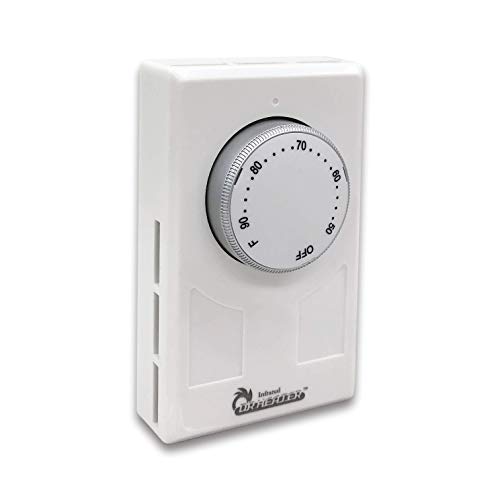
Dr. Infrared DR-001 Wall Thermostat, 120-277V

LUX PSD010B 2-Wire Heat-Only Thermostat
Why These Options Stand Out
The Cadet BTF2W is purpose-built for one job: snapping onto the end of a Cadet F series electric baseboard heater and controlling it from right there. A double-pole design means it actually breaks both hot legs of the 120/208/240 volt circuit, which gives you a true off position and a noticeable safety advantage during seasonal shutoff. The white housing blends cleanly into standard baseboard trim, and the oversized twist dial makes temperature setting a no-look operation in a dark hallway.
For anyone already running Cadet F series heaters, this is the path of least resistance. It eliminates extra wall wiring, sits at the heater end where you’d expect the control, and handles a 22 amp load comfortably for whole-room heating.
Where It Excels
- True double-pole switching cuts both hot legs, providing a genuine off state for off-season storage and maintenance safety
- End-mount design removes the need for a wall box or additional wire runs, cutting installation time considerably
- 22 amp rating covers most residential baseboard heaters up to roughly 5,000 watts at 240 volts
- Large twist dial is easy to operate in low light, and the white housing matches standard trim
- Temperature range of 45–80°F covers the practical comfort window without unnecessary extremes
Trade Offs
- Only fits Cadet F series baseboard heaters, so it’s not a universal replacement option
- Manual dial only, with no programmable schedule or smart features for energy savings
Who It Suits Best
Homeowners with existing Cadet F series baseboard heaters who want a clean, integrated control without pulling new wire through the wall.
Where Another Pick Suits Better
The Honeywell CT410A is a better match if you need a universal wall-mounted manual thermostat for a mix of baseboard brands or 277 volt commercial setups.
The Aube TH106 brings real scheduling to the line voltage world, and that’s a meaningful upgrade from a basic dial. A 7-day programmable layout lets you set different comfort levels for every day of the week, which matters more than people expect in rooms that sit empty during weekday work hours. Compatibility spans electric baseboard, convector, fan-forced, and even radiant ceiling systems, so it covers the common line voltage heating types found in older homes and additions.
The minimum 2 amp load rating means it won’t function with very small heater wattages, but for typical room-sized baseboards it’s a solid fit. Battery-free backup is a quiet highlight, retaining your schedule through power outages without you having to reprogram anything.
What Works In Its Favor
- 7-day programming adapts to irregular schedules, including split work weeks or rotating shifts
- Broad compatibility covers baseboard, convector, fan-forced, and radiant ceiling heaters in one unit
- Battery-free memory preserves your schedule through outages, which is rare in this category
- Handles up to 2000 watts at 120V or 4000 watts at 240V, covering most room and zone applications
Points To Keep In Mind
- 2 amp minimum load rules out low-wattage installations like small bathroom heaters
- Not compatible with inductive loads, so it won’t work with heaters that combine a resistive element and a blower fan
- Programming interface requires a short learning curve, especially for first-time programmable users
Key Product Details
Made For
Households with predictable weekly routines who want automatic setback and recovery without touching the dial after the initial setup.
Skip It When
The LUX ELV4 is a smarter pick if you want four program periods per day for tighter temperature curves around work and sleep hours.
The X2P targets homeowners who want a sensible programming model without the complexity of a full 7-day schedule. A 5-2 day layout means you set one program for Monday through Friday and a separate one for Saturday and Sunday, which matches how most households actually live. It works with single-stage 1 heat / 1 cool conventional systems, a useful note for anyone repurposing the thermostat in a mixed HVAC setup.
Customization extends to filter change reminders and display settings, which is a small but appreciated detail in a category that often ignores them. The white housing fits standard decor and the screen stays readable in most lighting.
Bright Spots
- 5-2 day programming simplifies setup while still capturing the meaningful weekday/weekend split
- Optional non-programmable mode lets you start simple and add scheduling later if your routine changes
- Filter change reminders reduce the “I forgot” problem that hurts HVAC efficiency over time
- Display customization options improve readability in bedrooms, hallways, or bright living areas
Worth Noting
- Optimized for single-stage 1 heat / 1 cool systems, limiting use in multi-stage or heat pump setups
- Configuration and advanced settings sit behind a menu structure that can feel dense for first-time users
Best Suited To
Families with consistent weekday routines and a clearly different weekend pattern who want automated comfort without daily interaction.
Not Your Match When
The Aube TH106 fits better if you need full 7-day independent scheduling or compatibility with line voltage baseboard and convector heaters.
The CT410A is a long-running manual thermostat that’s been a staple in electric baseboard installations for decades. This particular listing is a refurbished unit, cleaned and tested to work like new, which drops the price for homeowners who just need basic dial control. It handles radiant cable, electric baseboard, and resistive-rated fan-forced heaters, giving it genuinely broad compatibility for older systems.
The 22 amp rating at 120–240V and 19 amp rating at 277V covers most residential and light commercial line voltage heating loads. For a no-frills replacement where programmability doesn’t matter, it does the job reliably.
A Strong Showing
- Broad compatibility with radiant cable, baseboard, and fan-forced heaters widens replacement options
- 22A at 120–240V and 19A at 277V covers nearly all residential line voltage heating scenarios
- Refurbished pricing makes it a cost-effective swap for a failed or aging thermostat
- 40–80°F temperature range suits typical room comfort needs without unnecessary granularity
Some Limits To Know
- Refurbished condition means cosmetic wear may vary from a brand-new unit
- Manual dial only, with no scheduling, backlight, or energy-saving features
- May arrive in generic packaging with basic accessories rather than full retail kit
Quick Facts
Whose Shelf It Belongs On
DIYers replacing a failed manual baseboard thermostat on a budget who don’t need programmability or advanced features.
Look Elsewhere When
The Dr. Infrared DR-001 is a stronger fit if you need 277V commercial handling with a true OFF position on a higher-amp circuit.
The LUX ELV4 is built for people who want more granularity than a basic programmable thermostat offers. Four program periods per day (morning, day, evening, night) let you carve a temperature curve that matches when you actually use each room, which is where real energy savings show up. On-screen programming keeps the setup process visible rather than hidden behind button combinations.
A temporary override function covers the “I’m home sick today” scenario without throwing your whole schedule out the window. The catch, and it’s an important one, is that this thermostat is not compatible with heaters that combine a resistive element and a blower fan.
Advantages To Know
- Four daily periods allow tighter temperature control around actual occupancy patterns
- On-screen programming reduces the trial-and-error that plagues many programmable thermostats
- Temporary override handles one-off schedule changes without permanently resetting the program
- Separate programming for weekdays and weekends adapts to typical family routines
Practical Considerations
- Not compatible with combination resistive-and-fan heating systems, ruling out some fan-forced heaters
- UL approval is a safety plus, but the spec sheet requires careful matching to your heater type before purchase
The Right Fit
Energy-conscious homeowners with consistent daily routines who want precise temperature setbacks during predictable away hours.
Swap It Out When
The Aube TH106 is a better match if your heating includes fan-forced units, since it supports fan-forced and radiant ceiling compatibility.
The DR-001 is the workhorse of this list, and it shows up when the heating load gets serious. It handles single-pole and double-pole circuits at 120, 208, 240, and 277 volts, which covers everything from a small residential room to a light commercial shop. Maximum wattage scales with voltage: 3360W at 120V, 5824W at 208V, 6720W at 240V, and 7756W at 277V.
A flush wall-mount design with a large adjustment knob keeps the unit accessible without intruding on the room. The double terminals with OFF position give you the same safety advantage as the Cadet: both hot legs break when you turn it off, so there’s no live voltage at the heater during maintenance.
Where It Helps
- 120–277V range covers residential and commercial voltage standards in a single unit
- Up to 7756W capacity at 277V handles large heaters, workshops, and commercial zones
- Double-pole OFF position cuts both hot legs for safe seasonal shutdowns and service work
- Flush wall mount keeps the profile low in high-traffic or narrow spaces
- 41–90°F control range spans both comfort cooling-adjacent heating and warmer utility spaces
Possible Compromises
- Non-programmable design means no automatic setback for energy savings, even at commercial scale
- Larger capacity comes with larger physical footprint compared to compact residential models
- Hardwired 4-wire install requires a junction box and may be overkill for single small rooms
Feature Snapshot
Built With In Mind
Workshops, garages, basements, and light commercial spaces with high-wattage heaters needing 277V or large 240V circuits.
Consider Something Else When
The Cadet BTF2W is a better match for standard residential rooms running Cadet F series baseboard heaters under 5,000 watts at 240V.
The PSD010B is a specialist tool, and it does its one job without overcomplicating things. It’s designed for heat-only systems: fireplaces, stoves, and in-floor radiant heating, where you don’t need a fan switch or cooling mode cluttering the interface. The 2-wire setup makes it a clean replacement for older mechanical thermostats in those applications.
Installation is straightforward with clear instructions, which is a real plus for homeowners tackling a DIY project without an electrician. The non-programmable design keeps the wall control simple, with a basic dial for temperature setting.
The Helpful Details
- Purpose-built for heat-only systems like fireplaces, stoves, and in-floor radiant heating
- 2-wire installation drops into existing low-voltage-style wiring without neutral requirements
- No fan switch simplifies the wall control for applications where a blower is irrelevant
- Clear instructions make it accessible for confident DIY installations
Where It Is Less Suited
- Heat-only design means it’s not a candidate for homes with central air conditioning on the same wall control
- Non-programmable operation offers no automatic setback, so you’ll adjust manually for energy savings
- Specialty focus means it won’t fit general-purpose baseboard replacement jobs outside its target systems
Essential Details
Right Fit For
Homeowners adding a wall control to a fireplace conversion, wall-mounted stove, or in-floor radiant heating zone in a renovation.
Where Another Pick Suits Better
The Honeywell CT410A is the better call for traditional electric baseboard heaters, which fall outside the PSD010B’s heat-only specialty.
What To Weigh Before Choosing a 2 Wire Line Voltage Thermostat
Match The Thermostat To Your Heater Type
Line voltage thermostats are not universal. Electric baseboard, convector, fan-forced, and radiant ceiling heaters each have different load characteristics, and a thermostat rated for one may not work safely with another. A fan-forced heater combines a resistive heating element with an inductive blower motor, and many programmable models specifically exclude that combination. Check the heater’s nameplate voltage (120, 208, 240, or 277) and amperage draw before matching, since undersizing the thermostat creates a real fire risk over time.
Consider Double-Pole Vs. Single-Pole Switching
A single-pole thermostat (SPST, meaning it breaks only one hot leg) leaves the heater electrically live even when turned off, which matters for seasonal storage and maintenance. A double-pole thermostat (DPST, breaking both hot legs) provides a true off state, isolating the heater from the supply. The Cadet BTF2W and Dr. Infrared DR-001 both offer double-pole designs, while others in this list use single-pole switching. Homes with curious children, vacation properties, or heaters near water benefit from the extra safety margin of double-pole designs.
Think About Programming Complexity
A manual dial is genuinely easier to operate for households without a consistent routine, and the simplicity comes with fewer things to break. Programmable models like the Aube TH106 and LUX ELV4 deliver real energy savings through automatic setbacks, but they require initial setup effort and occasional schedule adjustments. The 5-2 day format on the X2P strikes a middle ground for families with a stable weekday pattern and a different weekend one.
Check The Amperage And Wattage Headroom
Every thermostat has a maximum load rating at each voltage it supports. Exceeding that rating causes relay failure, and the symptoms often start as clicking noises before the unit gives up entirely. The Dr. Infrared DR-001 handles the highest loads in this list at 7756W on 277V circuits, while smaller residential units cap out around 4000–5000W at 240V. If your heater sits at 80% or more of the thermostat’s rated capacity, step up to the next tier for thermal margin.
Key Considerations Across These Picks
Mistakes Worth Dodging
The most common slip-up is assuming a 2-wire thermostat will work with any heater, regardless of the heater’s electrical design. Inductive loads (motors, blower fans) need thermostats rated for inductive switching, and resistive-only units can weld their relay contacts shut if installed on a fan-forced system. Another frequent miss is ignoring the minimum load rating, since some programmable models refuse to operate below 2 amps and leave you with a dead display. Always confirm voltage, amperage, and load type before ordering.
The Case For Spending Up
Higher-tier thermostats earn their premium through scheduling flexibility, battery-free memory, and broader heater compatibility. The Aube TH106’s 7-day programming and outage-proof memory deliver measurable energy savings that cheaper manual dials can’t match, paying back the upgrade over a few heating seasons. For commercial or high-wattage applications, the Dr. Infrared DR-001’s 277V capability and double-pole safety simply aren’t available at the entry level, and the upgrade is more about capability than comfort.
Frequently Asked Questions
What Does “2 Wire” Mean For A Line Voltage Thermostat?
It means the thermostat switches the full heating voltage using just two conductors, with no separate low-voltage control circuit. This matches the wiring in most older homes with electric baseboard or radiant heat, allowing a direct replacement without running new cable through the walls.
Can I Use A Programmable Thermostat With Fan-Forced Heaters?
It depends on the model. Some programmable units, including the Aube TH106, are specifically rated for fan-forced heaters, while others like the LUX ELV4 exclude combination resistive-and-fan systems. Check the thermostat’s documentation for inductive load support before connecting it to a fan-forced unit.
Is Double-Pole Switching Worth The Extra Cost?
For seasonal properties, garages, or any space where a heater gets turned off for months, yes. Double-pole switching breaks both hot legs and provides a true electrical isolation, which makes maintenance and off-season storage safer. For primary residences with year-round heating, it’s a nice-to-have rather than a must.
Will A Higher Wattage Rating Damage A Smaller Heater?
No, a thermostat rated for higher wattage than your heater draws will simply operate well below its capacity. The risk goes the other direction: a thermostat rated below the heater’s draw will overheat its relay and fail prematurely. Oversizing the thermostat is safe and often recommended for thermal margin.
Do These Thermostats Need A Neutral Wire?
Most 2-wire line voltage thermostats do not require a neutral, since they only interrupt the hot conductor. Some advanced models with backlit displays or smart features may need a neutral for internal electronics, but the standard mechanical and basic programmable units in this list work with just the two heating conductors.