

You don’t think about the air filter sitting in your return vent until the dust bunnies start multiplying, the furnace runs louder than it should, or allergy season arrives early. Choosing the right 16 X 24 X 1 Air Filters keeps the air moving cleanly without choking your HVAC system. The seven options below balance particle capture, airflow, and replacement cost, so you can match a filter to your home, your health priorities, and how often you want to remember to swap it.
The Main Contenders

Nordic Pure 16x24x1 Pleated MERV 8 Air Filters 6 Pack
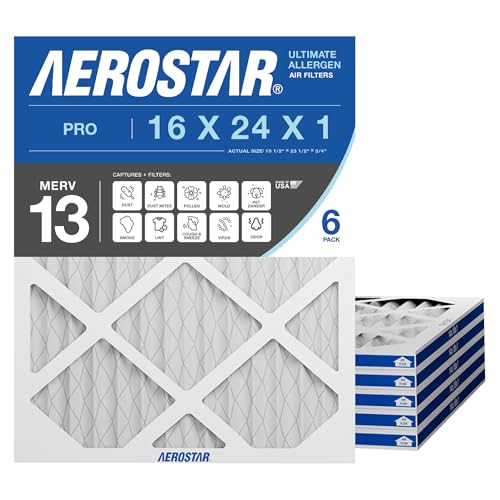
Aerostar 16x24x1 MERV 13 Pleated Air Filter 6 Pack

Filtrete 16x24x1 MERV 8 Electrostatic Air Filter 6-Pack

Chenzhit 16x24x1 MERV 13 Pleated Air Filter 6 Pack

Filterbuy 16x24x1 MERV 8 Dust & Allergy Defense 6-Pack

Filter King 16x24x1 MERV 8 AC Furnace Filter 12-Pack

Filterbuy 16x24x1 MERV 8 Dust & Allergy Defense 2-Pack
A Breakdown Of The Leading Choices
Nordic Pure’s MERV 8 (Minimum Efficiency Reporting Value, a 1–16 scale where higher numbers trap smaller particles) pleated filter is the kind of workhorse you install once and forget about for a couple of months. The actual dimensions run 15.5″ x 23.5″ x 0.75″, so it tucks into a standard 16x24x1 slot with the snug tolerance most return-air grilles expect.
For households without severe allergies, this filter balances particle capture with steady airflow, which keeps the blower from straining. It pairs well with standard gas furnaces, central air handlers, and heat pump systems. If you’re stepping up from a basic fiberglass panel, the synthetic media holds more dust before it loads up.
Key Advantages
- MERV 8 synthetic pleated media catches household dust, lint, and pollen without choking airflow
- Six-pack format covers roughly six months of routine 30–90 day swaps
- Manufactured domestically, which usually means tighter quality control on the frame
- Standard 0.75″ depth slides into common 1″ filter racks without forcing the door
Things To Consider
- Won’t trap the finest particles like smoke or airborne bacteria, so allergy households may want to step up to a MERV 11 or 13
- Actual size is slightly smaller than the nominal 16x24x1, so measure your slot first to avoid gaps around the edges
Feature Snapshot
Who It Suits Best
You want a dependable, no-fuss filter for a typical single-family home with a forced-air furnace, central AC, or heat pump.
Where Another Pick Suits Better
Pet owners and allergy sufferers should consider the Aerostar MERV 13 instead, since it traps smaller dander and fine particles.
The Aerostar steps up to MERV 13, a step on the rating scale designed to catch finer contaminants between roughly 0.3 and 1.0 microns, including dust mites, mold spores, pollen, and pet dander. The electrostatic synthetic media actively pulls particles in, rather than just letting them bump into fibers.
Where the Nordic Pure handles everyday household dust, this one is tuned for people whose HVAC system needs to actually clean the air, not just protect the blower coil. In our view, the upgrade makes sense the moment you share a home with shedding pets or someone who wakes up congested every March.
Advantages To Know
- MERV 13 rating aligns with MPR 1500–1900 and FPR 10, which are 3M Filtrete and Honeywell proprietary scales comparable to MERV
- Electrostatic media pulls in fine particles that slip past cheaper MERV 8 panels
- Six filters give you roughly half a year of protection at the standard 60–90 day cycle
- Comparable to residential allergy-grade filters sold at HVAC supply counters
Worth Noting
- Higher MERV ratings restrict airflow more than a MERV 8, so older or undersized blowers may sound louder as the system pushes harder
- You’ll need to replace these on schedule, since loaded MERV 13 media can drive up energy use if ignored
Key Product Details
Made For
Allergy-prone households with shedding pets, recent wildfire smoke events, or family members who notice dust on every surface within a day of cleaning.
Look Elsewhere When
You live in a small apartment with a basic blower and no air quality concerns, since the Filterbuy MERV 8 will do the job while keeping strain off the equipment.
Filtrete brings electrostatic charging to the MERV 8 tier, which is a small but meaningful upgrade over plain pleated media. MPR 700 sits in the brand’s middle tier, designed to catch pollen, dust, and pet dander without the airflow penalty you’d get jumping all the way to MERV 13.
Compare that to the Nordic Pure, which uses mechanical filtration, and the difference shows up in the way charged fibers actively attract particles. Depending on your home’s pollen load, that electrostatic pull can mean visibly cleaner vents after a single season.
A Few Strong Suits
- 3M’s electrostatic media holds allergens in place instead of letting them slide off when the blower cycles
- Listed as a 3-month pleated filter, so the six-pack covers a full year of routine changes
- Engineered for low airflow resistance, which protects blower motors and keeps energy use steady
Trade Offs
- Actual dimensions at 15.81″ x 23.81″ are tighter than some alternatives, so measure the slot to make sure it seats without bowing
- Filtrete replacement filters are typically a touch pricier per filter than the generic MERV 8 options on the list
Technical Reference
Right Fit For
You live in a pollen-heavy region and want allergen filtration stronger than a basic panel filter, without the airflow cost of jumping to MERV 13.
Skip It When
You need finer-than-MERV-8 particle control because of smoke or severe allergies, in which case the Aerostar MERV 13 is the better step up.
Chenzhit positions itself as a MERV 13 alternative with cross-brand rating alignment to MPR 1900 and FPR 10, which is a useful framing for anyone who’s shopped 3M or Honeywell lines before. The actual size runs 15.75″ x 23.75″ x 0.75″, a familiar fit for a 16x24x1 slot.
You may find the value angle is the bigger story here, since the 6-pack offers MERV 13 performance at a budget tier price point. It’s a sensible fit for households that want stronger allergen filtration without paying for a name-brand premium.
Standout Benefits
- MERV 13 media captures fine particles comparable to the Aerostar, including dander and pollen
- Cross-reference ratings (MPR 1900, FPR 10) make it easy to compare against Filtrete and Honeywell lines
- Six-pack format supports a six-month rotation at standard replacement intervals
Honest Caveats
- Less of a household-name reputation than Nordic Pure or Filtrete, so build consistency may vary run to run
- Same airflow trade-off as any MERV 13 filter in an undersized system, so check your blower specs
Core Details
Who Should Grab It
You want MERV 13 allergen protection, value a cross-brand rating reference, and prefer buying in multi-packs for routine swaps.
Swap It Out When
You’re willing to spend more for a long-established brand track record, in which case the Aerostar MERV 13 is the safer bet.
Filterbuy’s MERV 8 is a sensible everyday filter that aims to catch roughly 90% of common household dust without dragging down airflow. It cross-references to MPR 700 and FPR 5, putting it on the same general tier as the Filtrete MPR 700 option earlier in the list.
For busy households that go through filters quickly, the 6-pack hits a friendly price-per-filter point. The actual dimensions sit at 15.38″ x 23.38″ x 0.75″, which is the tightest actual size on this list, so measuring your slot before ordering is well worth the minute it takes.
Real-World Strengths
- MERV 8 synthetic media captures pollen, lint, and household dust without major airflow loss
- Compatible with furnaces, central air handlers, and heat pump systems
- Six-pack lowers the per-filter cost for households that swap every 60 days
Points To Keep In Mind
- Won’t trap fine particles like smoke or cooking aerosols, so kitchens with heavy stovetop use may need higher MERV
- Actual size runs a bit smaller than the nominal 16x24x1, so check the slot depth before installing
Best Suited To
Homeowners running a standard forced-air system who want straightforward dust defense at a budget-friendly per-filter cost.
A Better Fit Elsewhere
The Filter King 12-pack is the smarter pick for anyone who wants a year’s worth of filters in one box and prefers buying in bulk.
Filter King leans into volume. A 12-pack of MERV 8 pleated filters covers an entire year of routine swaps at the standard 30–90 day cycle, which suits anyone who’d rather buy once than remember to reorder every other month. The actual size runs 15.5″ x 23.5″ x 0.75″, matching the Nordic Pure footprint.
In most homes, MERV 8 is the sweet spot for basic protection. This filter handles dust, pollen, and lint while keeping energy use stable, making it a sensible workhorse for second homes, rental properties, or households with multiple return vents.
What Stands Out
- 12 filters in one box, enough for a year of routine service without reordering
- Listed life up to 90 days per filter, matching the typical 1-inch pleated service window
- Standard MERV 8 rating protects HVAC components without choking airflow
Soft Spots
- Storage matters with 12 filters, so a closet shelf or garage corner is helpful to keep cardboard flat
- Won’t catch fine smoke or cooking particles, so kitchens with heavy frying may still notice a film
Perfect Match For
You have multiple filters to swap across the home, manage a rental, or just want a year’s worth of replacements on a single shelf.
Another Choice May Suit
First-time filter shoppers who aren’t sure of the fit should start with the Filterbuy 2-Pack before committing to a 12-pack.
Same MERV 8 synthetic media as the Filterbuy 6-Pack, but in a 2-count. It’s a smart format for newcomers who want to test fit and performance before scaling up to a larger supply. The 15.38″ x 23.38″ actual size is identical to the 6-pack sibling, so swapping between the two is seamless.
For renters, condo owners, or anyone confirming the right size before committing, this small pack is the right entry point. Once you’ve confirmed the fit, the 6-pack or 12-pack becomes the more economical rotation.
The Value In It
- Small pack size is perfect for verifying fit before buying in bulk
- Same MERV 8 synthetic media as the 6-pack version, so performance stays consistent
- Cross-references to MPR 700 and FPR 5 for easy comparison with other brands
Small Caveats
- Per-filter cost runs higher than the 6-pack or 12-pack options, so it doesn’t reward long-term use
- Won’t catch the smallest particles, so severe allergy households should look at the MERV 13 picks instead
Who Will Love This
You want to confirm filter fit, performance, and airflow before committing to a larger supply, especially in a new home or apartment.
Reach For A Different Pick When
You already know you want year-round coverage, in which case the Filter King 12-Pack is the better long-term rotation.
What Matters Most When Picking A 16 X 24 X 1 Filter
Match The MERV Rating To Your Air Quality Goals
MERV ratings tell you how small a particle the filter can trap. MERV 8 handles dust, lint, and pollen, which covers most homes. MERV 11 and 13 step into pet dander, fine dust, and smoke territory, but they also restrict airflow more, so check that your blower can handle the resistance before upgrading.
Get The Actual Size Right, Not Just The Nominal
The “16x24x1” label is a nominal measurement, and the actual filter is almost always a fraction smaller so it slides into the rack. If the actual dimensions are off, air leaks around the filter frame, which means unfiltered air slips into the return duct. Measure your existing filter or the slot itself before reordering.
Pick A Pack Size That Matches Your Routine
Multi-packs lower per-filter cost but only if you’ll actually use them before they sit too long in storage. A 6-pack covers roughly six months at standard 60–90 day cycles, while a 12-pack covers a full year. Renters and newcomers often do better starting with a 2-pack to confirm fit.
Balance Filtration With Airflow
The tighter the filter media, the more work the blower does. Higher-MERV filters can drive up energy use in older or undersized systems. If you notice weak airflow at the registers, the issue may be the filter, not the ductwork, so stepping down a MERV tier can help.
Key Considerations Across These Picks
Wrong Turns To Avoid
A common slip-up is buying on nominal size alone and ending up with a filter that bows or leaves gaps. Another is jumping to the highest MERV rating without checking whether your blower can handle the resistance, which can quietly inflate energy use. Buying too small a pack and running filters past their service window is the third trap, since a loaded MERV 13 filter chokes airflow faster than a MERV 8 would.
When Paying More Pays Off
The premium tier on this list, the MERV 13 picks like Aerostar and Chenzhit, costs more per filter because the electrostatic media is denser and rated to capture finer particles. The upgrade pays off in homes with shedding pets, recent smoke exposure, or allergy sufferers who notice dust within a day of cleaning. For households without those concerns, a MERV 8 like the Nordic Pure or Filter King does the job at a friendlier per-filter cost.
Frequently Asked Questions
How Often Should A 16x24x1 Air Filter Be Changed?
Most 1-inch pleated filters should be swapped every 30 to 90 days, depending on home size, pet load, and filter density. MERV 13 media loads up faster, so allergy households may want to stay on the 30–60 day side.
What Is The Difference Between MERV 8 And MERV 13?
MERV 8 captures larger particles like dust, lint, and pollen, while MERV 13 also traps finer contaminants such as pet dander, mold spores, and smoke. The trade-off is airflow, since denser MERV 13 media restricts air more than a MERV 8 panel.
Why Is The Actual Filter Size Smaller Than 16x24x1?
HVAC filter slots are designed with a slight gap so the filter slides in without forcing. Manufacturers cut actual sizes like 15.5″ x 23.5″ or 15.75″ x 23.75″ to match that tolerance, which is why measuring your existing filter matters before reordering.
Can A MERV 13 Filter Damage An Older Furnace?
A MERV 13 filter can increase static pressure in an older or undersized blower, which may make the furnace work harder and shorten equipment life. Checking your system’s airflow rating before stepping up to MERV 11 or 13 is a smart move.
Is A Pleated Filter Better Than A Fiberglass Panel?
Pleated filters use denser synthetic media and a higher MERV rating, so they catch more particles than a basic fiberglass panel. Fiberglass panels are cheaper and protect the equipment, but pleated filters do a noticeably better job cleaning the air you actually breathe.